Product Pricing Calculator: Materials, Labor, Fees and Margin in One Sheet
Product pricing calculator: price one candle from materials, labor, equipment, packaging and fees. A $7.85 unit cost becomes a $15.70 price at a 40% margin.
By Small Business Bundle by Cosmo Suite · Editorial policy
Published · 8 min read
A product pricing calculator turns your costs into a price you can defend. Add up materials, your labor, equipment and extras to get a unit cost, then divide it by one minus the margin you want: price = unit cost ÷ (1 − margin).
Most small sellers skip that step entirely. They add up the supplies, double the number and hope. Doubling feels safe. Yet when the supplies are only part of the real cost, the price can land below what the item costs you and still look like a 100% markup.
Below is one candle priced from beginning to end with every calculation shown, followed by the sheet that repeats the same calculation for every item you sell.
In Short: list four cost groups, calculate a unit cost, choose a profit margin, leave room for platform fees, and let a spreadsheet handle the division.
One Candle, Priced Step by Step
A candle costing $7.85 to make needs a $15.70 price to earn a 40% margin after a 10% platform fee. Here is how the numbers get there, using a made-up batch of 10 soy candles. The figures are illustrative, so substitute your own.
| Cost group | What goes in | Per batch of 10 | Per candle |
|---|---|---|---|
| Materials | Wax $10.00, fragrance $6.00, jars $18.00, wicks $2.50, labels $2.00 | $38.50 | $3.85 |
| Labor | 90 minutes at $20 an hour | $30.00 | $3.00 |
| Equipment | A $60 pot and thermometer spread over 600 candles | $1.00 | $0.10 |
| Other | Box and packing supplies at $0.90 each | $9.00 | $0.90 |
| Unit cost | $78.50 | $7.85 |
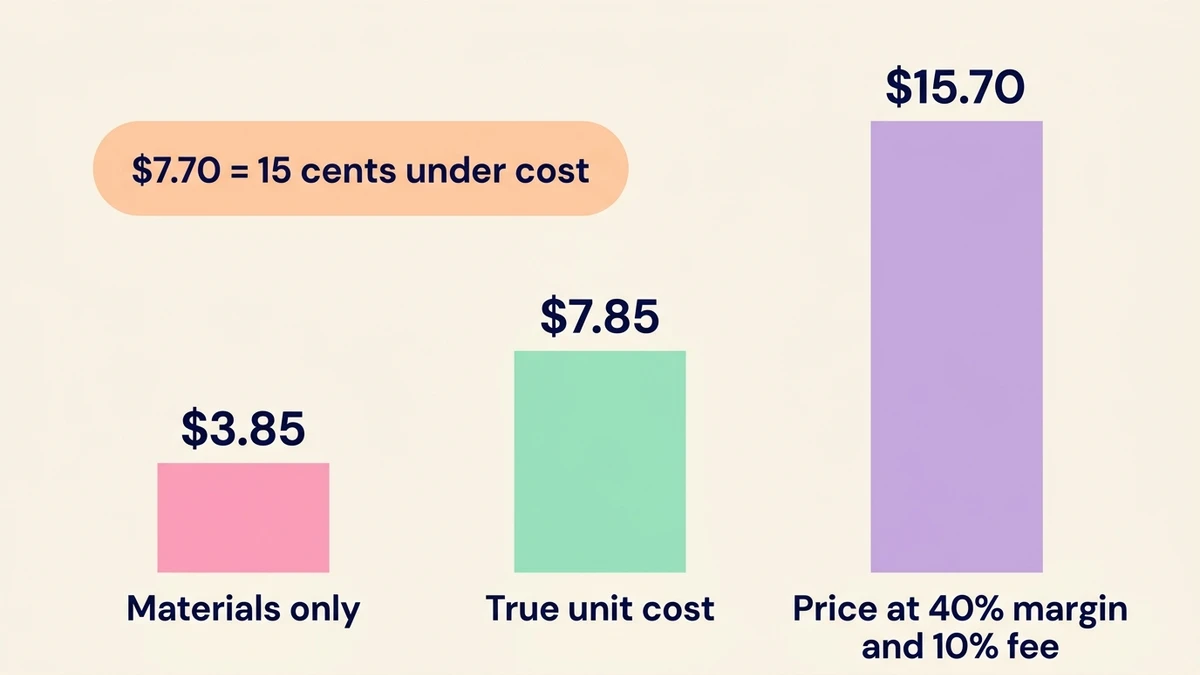
The materials alone come to $3.85, which is less than half of the real cost. A seller who prices from the wax and jars receipt sees only that first row of the table.
Now look at the price. A 100% markup on the full cost is $7.85 × 2 = $15.70. The same markup applied to materials only gives $3.85 × 2 = $7.70, which is 15 cents under the true cost. Every candle sold at that price loses money while the order book fills up.
The IRS reasons in the same direction for businesses that sell goods. Publication 334 treats materials and supplies, direct labor and other costs such as containers as parts of the cost of goods sold, not as extras. If the tax form counts your labor as a cost, your price should account for it as well.
Use it when: you have ever set a price from the supplies receipt alone.
Step 1: Cost the Four Groups
Every price starts from four cost groups: materials, labor, equipment and other costs. The unit cost is the total of those four groups for one item, and if you miss a group, the unit cost is wrong before you have even chosen a margin.
Materials: price every ingredient per item
List each material with its quantity and price, then divide the batch total by the number of items, which in the example is $38.50 over 10 candles, or $3.85. Include the small things such as labels and wicks, because they repeat on every unit you make.
Use it when: you buy supplies in bulk and the cost per item is a guess.
Labor: pay yourself an hourly rate
Time one real batch, from setting up the workspace to sealing the last box, and multiply those hours by an hourly rate you would honestly accept as pay. In the example, 90 minutes at $20 an hour is $30.00 a batch, or $3.00 a candle. Leaving labor at zero is probably the most common reason handmade prices end up unsustainably low.
Use it when: you make the item yourself and have never counted your own hours.
Equipment and other costs: spread the wear, add the extras
Equipment is a one-off purchase that wears out over time. Divide its price by the number of items it will help you make: $60 over 600 candles is $0.10 each. Other costs are the per-item extras such as the box, the tissue paper and a thank-you card, which come to $0.90 in the example.
Use it when: your tools and packaging never show up in your prices.

Step 2: Pick a Margin, Then Work Back to the Price
Choose the margin you want, then divide the unit cost by one minus that margin. Profit margin is the share of the selling price you keep as profit. Shopify gives the same formula: target price = cost per unit ÷ (1 − desired profit margin as a decimal). For context, NYU Stern's sector data (January 2026) puts average gross margin at 26.31% for retail grocery and food and 56.88% for apparel, so a sensible target depends heavily on what you sell. The table runs the formula on the $7.85 candle.
| Method | Calculation | Price | Margin you actually get |
|---|---|---|---|
| 50% markup | $7.85 × 1.5 | $11.78 | 33.3% |
| 100% markup | $7.85 × 2 | $15.70 | 50.0% |
| 150% markup | $7.85 × 2.5 | $19.63 | 60.0% |
| 30% margin | $7.85 ÷ 0.70 | $11.21 | 30.0% |
| 40% margin | $7.85 ÷ 0.60 | $13.08 | 40.0% |
| 50% margin | $7.85 ÷ 0.50 | $15.70 | 50.0% |
Look at the table again: a 100% markup and a 50% margin produce exactly the same price, because they are two different ways of describing one number, and mixing them up is a common and expensive mistake. The rule to remember is that markup is the profit measured against cost, while margin is the profit measured against the price.
Use it when: you know the profit you want and need the price that delivers it.
Step 3: Leave Room for Fees and Discounts
A platform fee is a percentage of what the customer pays, so it has to sit inside the price instead of being subtracted afterwards. If a platform takes 10% of each sale and you still want a 40% margin, the sum becomes $7.85 ÷ (1 − 0.40 − 0.10) = $7.85 ÷ 0.50 = $15.70.
Check that price by working forward. The fee is $15.70 × 10% = $1.57, and the profit is $15.70 − $7.85 − $1.57 = $6.28, which divided by $15.70 is exactly 40%. The 10% is a sample figure, so look up your own platform's current fee page and enter the real rate.
Discounts work the same way. Take 10% off the $15.70 price and the sale is $14.13. The fee falls to $1.41 and the profit drops to $4.87. That is about 22% less profit in return for a 10% discount, so check that number before you run a sale.
Use it when: you sell on a marketplace or run promotions.
What Actually Keeps a Price Right
A price is only right on the day you calculated it, because supplier costs drift over the months. Four habits keep a price honest:
- Keep every cost in one place. When the price of wax increases, you change a single cell instead of ten separate notes.
- Re-price whenever a supplier changes. A jar that costs $0.20 more reduces the profit on every batch of 10 by $2.00.
- Calculate before you discount. Check the remaining profit at the lower price before announcing any promotion.
- Compare with what buyers actually pay. A formula identifies the lowest workable price, but whether customers will accept it is a completely separate question.
A well-built spreadsheet makes the first three habits almost automatic. A ready-made pricing sheet that keeps costs in one place does the division for you, so a new supply price updates every item at once.
Why Trust This Article
We are the Cosmo Suite team that built Small Business Bundle, so we have an interest in you using a spreadsheet. The formula comes from Shopify's pricing guide, the cost categories from IRS Publication 334 and the margin data from NYU Stern, all read on 5 October 2026. Methodology: we tested the formula on a made-up batch of 10 candles and checked every total by hand, for example $38.50 + $30.00 + $1.00 + $9.00 = $78.50. The candle figures are not customer results. Our editorial policy explains how we write, and about us says who we are and how to contact us. This is general information, not tax or financial advice, so check your own numbers with a tax professional.
How Small Business Bundle Handles This
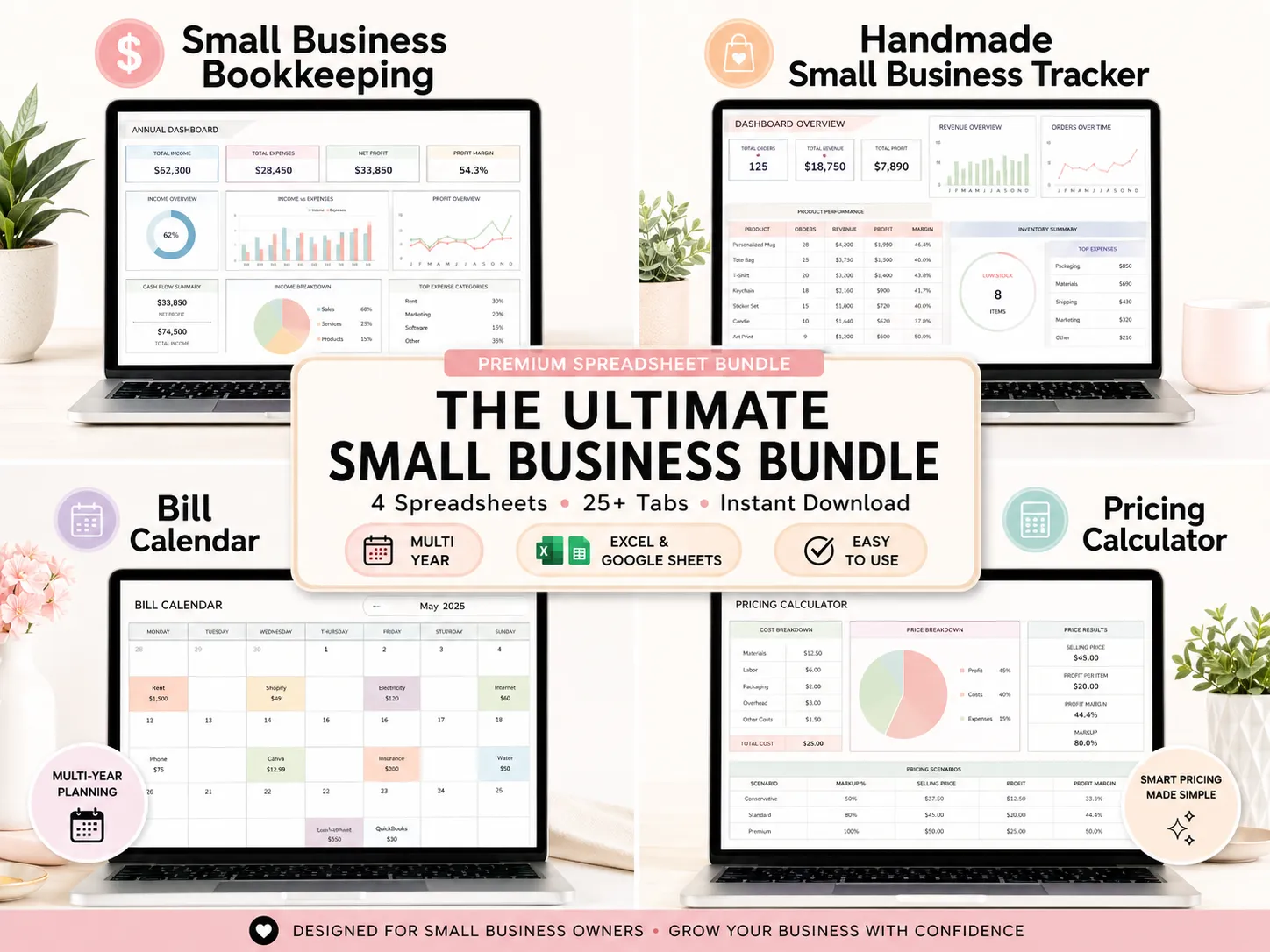
The main bottleneck in pricing is recalculating the same formula for every individual item. Small Business Bundle is 4 linked spreadsheets with 25+ tabs for Excel 365 and Google Sheets, sold as one instant download.
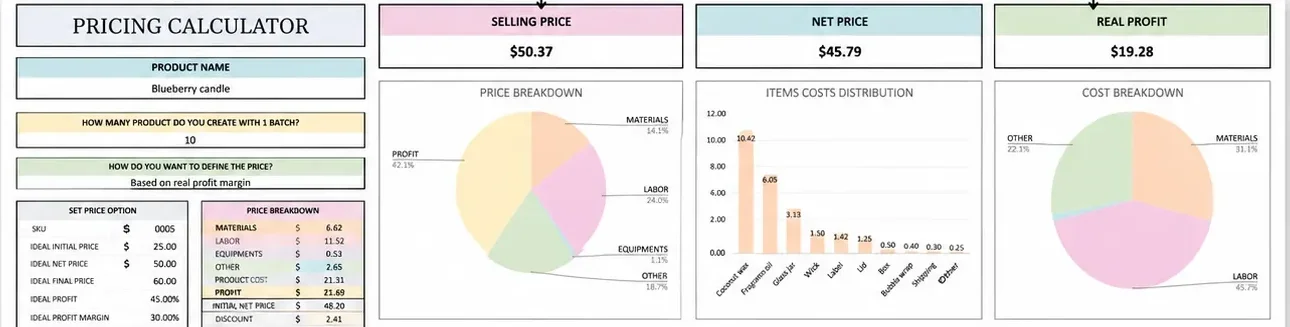
Its Pricing Calculator has 3 tabs. For each product you enter the batch size and the cost tables for materials, labor, equipment and other costs. You can define the price from a real profit margin, add a discount and sales tax, and read the selling price, net price and real profit. The Order & Customer Tracker uses the same workbook to track what sold.
It is not accounting software or a payment processing service. If you want a pricing calculator for every product you sell, in one file you own, it is a one-time purchase rather than a monthly subscription. For the wider picture, see our small business spreadsheet guide. Excel and Google Sheets are trademarks of their owners, and we are not affiliated with them.
Frequently Asked Questions
What should a product pricing calculator include?
Four cost groups and one target. The groups are materials, your labor, equipment and other costs such as packaging. The target is the profit margin you want. Add platform fees and any discount you plan to give, and the calculator can work back to a selling price.
Is a spreadsheet pricing calculator better than an online one?
It depends on how often you price. An online widget is quick for one item. A spreadsheet keeps your costs, so when wax or jars get more expensive you change one cell and every price updates. It also lets you experiment with different fees and discounts.
How do I include my own time in the price?
Pick an hourly rate you would accept as pay, time one batch from start to packing, and divide by the number of items. In the example here, 90 minutes at $20 an hour is $30.00 per batch, or $3.00 for each of 10 candles.
What profit margin should I aim for?
There is no single right number. NYU Stern's January 2026 sector data shows average gross margins of 26.31% for retail grocery and food and 56.88% for apparel. Start from your own costs, pick a margin you can live on, and check it against what buyers pay.
Should the price include platform fees?
Yes. Fees come out of the price you charge, so leave appropriate room for them before you set a margin. In the worked example, a 10% fee turns a $13.08 price into a $15.70 one at the same 40% margin. Check your platform's current fee page for the real rates.
How often should I re-check my prices?
Re-check whenever a significant supply cost changes, and at least once every year. With a spreadsheet, you update the changed material price and read the new selling price straight away, so the check takes a few minutes.
Frequently asked questions
What should a product pricing calculator include?
Four cost groups and one target. The groups are materials, your labor, equipment and other costs such as packaging. The target is the profit margin you want. Add platform fees and any discount you plan to give, and the calculator can work back to a selling price.
Is a spreadsheet pricing calculator better than an online one?
It depends on how often you price. An online widget is quick for one item. A spreadsheet keeps your costs, so when wax or jars get more expensive you change one cell and every price updates. It also lets you experiment with different fees and discounts.
How do I include my own time in the price?
Pick an hourly rate you would accept as pay, time one batch from start to packing, and divide by the number of items. In the example here, 90 minutes at $20 an hour is $30.00 per batch, or $3.00 for each of 10 candles.
What profit margin should I aim for?
There is no single right number. NYU Stern's January 2026 sector data shows average gross margins of 26.31% for retail grocery and food and 56.88% for apparel. Start from your own costs, pick a margin you can live on, and check it against what buyers pay.
Should the price include platform fees?
Yes. Fees come out of the price you charge, so leave appropriate room for them before you set a margin. In the worked example, a 10% fee turns a $13.08 price into a $15.70 one at the same 40% margin. Check your platform's current fee page for the real rates.
How often should I re-check my prices?
Re-check whenever a significant supply cost changes, and at least once every year. With a spreadsheet, you update the changed material price and read the new selling price straight away, so the check takes a few minutes.