Markup vs Margin: The Difference That Quietly Costs Small Sellers Money
Markup vs margin: a 40% markup on a $20 item is only a 28.6% margin. See the table, the two conversion formulas and the price that really earns 40%.
By Small Business Bundle by Cosmo Suite · Editorial policy
Published · 8 min read
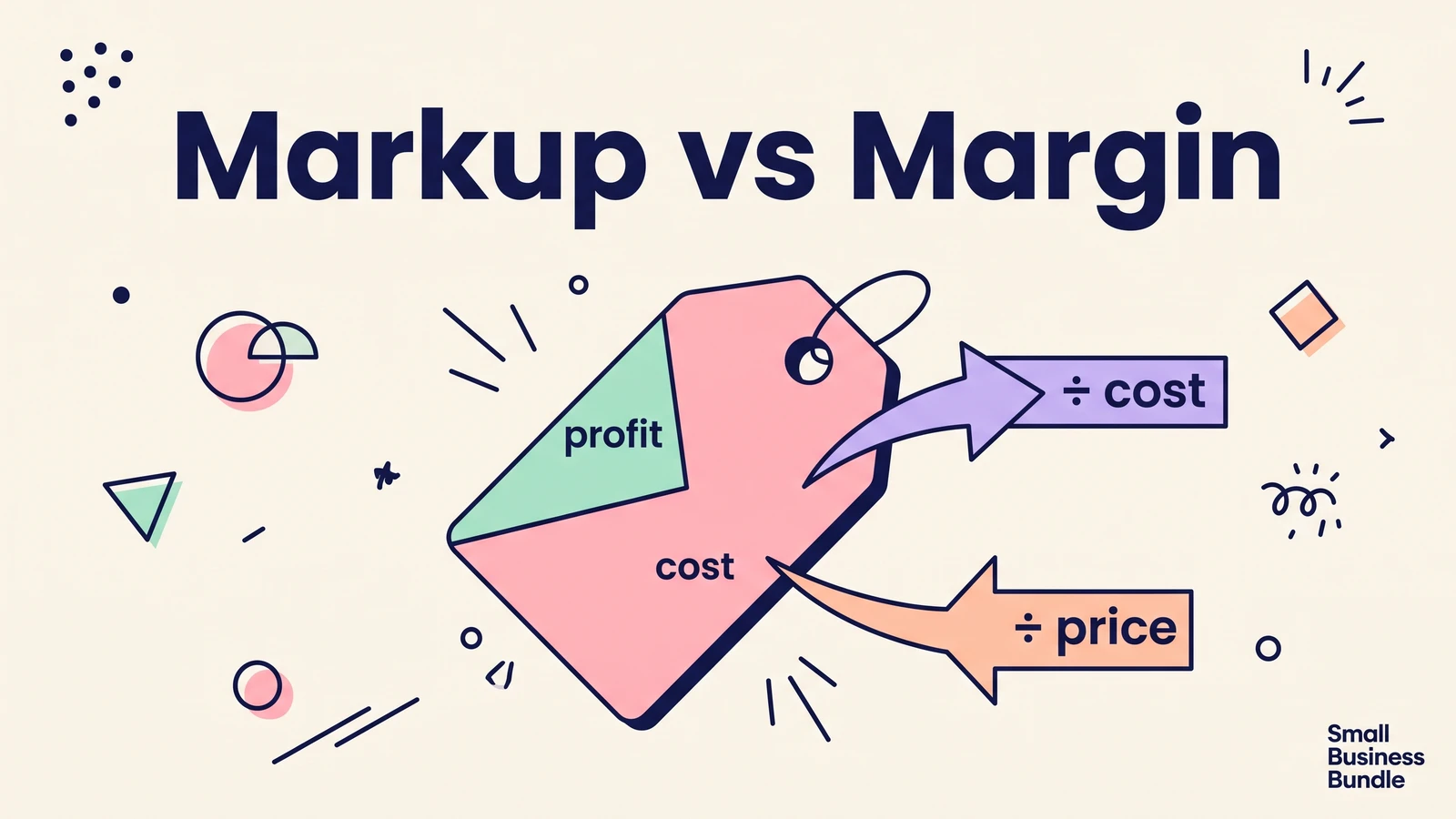
Markup vs margin comes down to one question: what do you divide the profit by? Markup is profit divided by the cost of the item, and margin is profit divided by the price the customer pays. The same sale therefore produces two different percentages, and the margin is always the smaller of the two.
Plenty of sellers use the two words as if they meant one thing. When they want to keep 40% of each sale, they add 40% to the cost and set the price accordingly. The price looks right on the tag, yet the profit it delivers is considerably lower than the 40% they intended.
Below is one $20 item worked through both ways, the table that converts one figure into the other, and the price that really earns the profit you are aiming for.
In Short: markup is profit ÷ cost, margin is profit ÷ price, and a 40% markup is only a 28.6% margin.
The Same $20 Item, Priced Two Ways
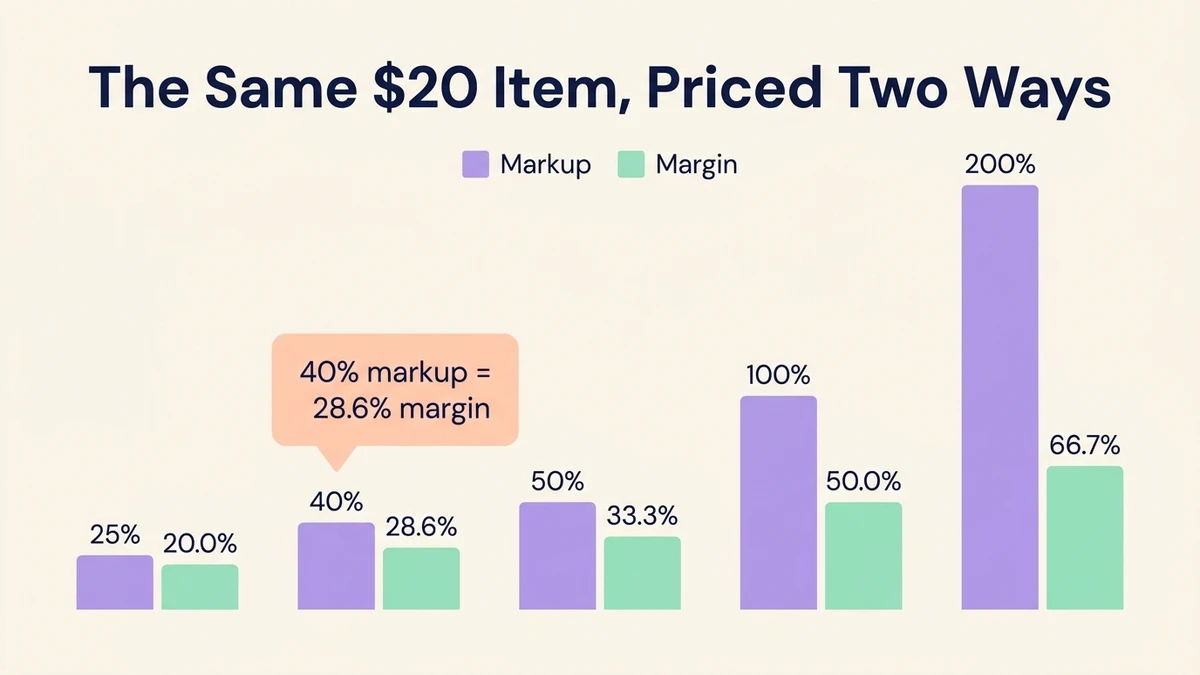
A $20 item sold at $28 has a 40% markup and a 28.6% margin, because the $8 profit equals 40% of the cost but only 28.6% of the price. Shopify's definitions are the same: markup is (price − cost) ÷ cost, and margin is (price − cost) ÷ price.
| Markup on a $20 cost | Price | Profit | Margin you actually get |
|---|---|---|---|
| 25% | $25.00 | $5.00 | 20.0% |
| 40% | $28.00 | $8.00 | 28.6% |
| 50% | $30.00 | $10.00 | 33.3% |
| 100% | $40.00 | $20.00 | 50.0% |
| 200% | $60.00 | $40.00 | 66.7% |
The profit in each row is an identical dollar figure under either name, because only the divisor changes between the two calculations. At a 25% markup you keep a fifth of every sale rather than a quarter, which is easy to miss when the price tag looks reasonable.
Now run it the other way, and say you want to keep 40% of the price. A 40% markup gives $28.00 and an $8.00 profit, which is only 28.6% of that price, while the price that earns 40% is $20 ÷ (1 − 0.40) = $33.33, with a profit of $13.33.
That gap is $5.33 on every item, and over a run of 100 items it adds up to $533 of profit that the word "markup" quietly took from you.
Use it when: you set prices by adding a percentage to your cost.
Markup and Margin at a Glance
Gross margin is the share of the selling price that is left after the cost of goods, while markup is the amount added on top of cost. Markup answers "how much did I add to what it cost me?" and margin answers "how much of what the customer paid do I keep?" The table puts them side by side.
| Markup | Margin | |
|---|---|---|
| Formula | (price − cost) ÷ cost | (price − cost) ÷ price |
| Divided by | Your cost | The price |
| Highest possible | No ceiling | 100% |
| Best for | Quick rules of thumb | Deciding what you keep |
| $20 cost, $30 price | 50% | 33.3% |
Margin is the figure that lines up with the rest of your costs, because platform fees, sales tax and discounts are all a share of the price and so they come off the margin directly. For context, NYU Stern's sector data (January 2026) reports gross margins, not markups, which is 26.31% for retail grocery and food and 56.88% for apparel. Markup tells you how you built the price, and margin tells you what the price leaves you.
Confusion between the two measurements is understandable, since retailers, suppliers and accountants use them interchangeably in conversation. Whenever somebody quotes a percentage to you, ask whether it is calculated against cost or against price, because the answer changes the interpretation completely.
Use it when: you are not sure which figure a calculator, supplier or marketplace report is showing you.
Converting One Into the Other
Two short formulas move you from one figure to the other, and Shopify's guide to pricing a product uses the same margin logic. The conversion rules are: margin = markup ÷ (100 + markup), and markup = margin ÷ (100 − margin), each as a percentage.
From markup to margin
Divide the markup by 100 plus the markup. A 60% markup gives 60 ÷ 160 = 37.5% margin, and a 100% markup gives 100 ÷ 200 = 50%, no matter what the item costs.
Because the margin is always smaller than the markup, a quoted markup can sound more generous than the profit it actually represents.
Use it when: a supplier or a friend quotes you a markup and you want to know what you would keep.
From margin to markup
Divide the margin by 100 minus the margin, so that a 40% margin gives 40 ÷ 60 = 66.7% markup and a $20 item therefore needs a $33.33 price. A 30% margin needs a 42.9% markup, and a 50% margin needs a markup of 100%, which is the familiar rule of doubling the cost.
Use it when: you know the profit you want and need the markup that delivers it.
Fees and Discounts Hit the Margin
A platform fee or a discount comes out of the selling price, so it removes margin points one for one. Keep the $28 price from the first example: a 10% fee is $2.80, so the profit falls from $8.00 to $5.20 and the margin falls from 28.6% to 18.6%.
The 10% is only a sample figure, so look up your platform's current fee page and use the real rate. The point holds for any rate, because the fee is a share of the price and the pricing calculation therefore has to include it before you decide that a price is profitable. For the full walk-through, see how to price a product from materials, labor and fees.
Use it when: you sell on a marketplace or run a sale.
What Actually Keeps You From the Mix-Up
The mix-up survives because each number sounds reasonable on its own. Four simple habits are enough to remove it:
- Say which one you mean. "Forty percent" is an ambiguous instruction, whereas "forty percent margin" is a precise one that anybody can calculate.
- Pick the margin first. Decide what percentage of every sale you intend to keep, then divide your cost by one minus that margin.
- Check the margin after any markup rule. A rule that says "double the cost" produces a 50% margin, while a rule that says "add 30%" produces only a 23.1% margin.
- Re-check when a cost changes. A higher supplier price shrinks the margin even when the markup percentage you apply stays exactly the same.
Doing that for one item takes about a minute. Doing it by hand for forty items is where mistakes creep in, which is why a pricing sheet that works from the margin you want is easier to trust than a rule you apply from memory.
Why Trust This Article
We are the Cosmo Suite team that built Small Business Bundle, so we have an interest in you using a spreadsheet. The formulas and the conversion rules come from Shopify's guides and the sector margins from NYU Stern, all read on 7 October 2026. Methodology: the $20 item is made up, and we checked every row by hand, for example $20 × 1.4 = $28.00 and $8 ÷ $28 = 28.6%. The figures are not customer results. Our editorial policy explains how we write, and about us says who we are and how to contact us. This is general information, not tax or financial advice, so check your own numbers.
How Small Business Bundle Handles This
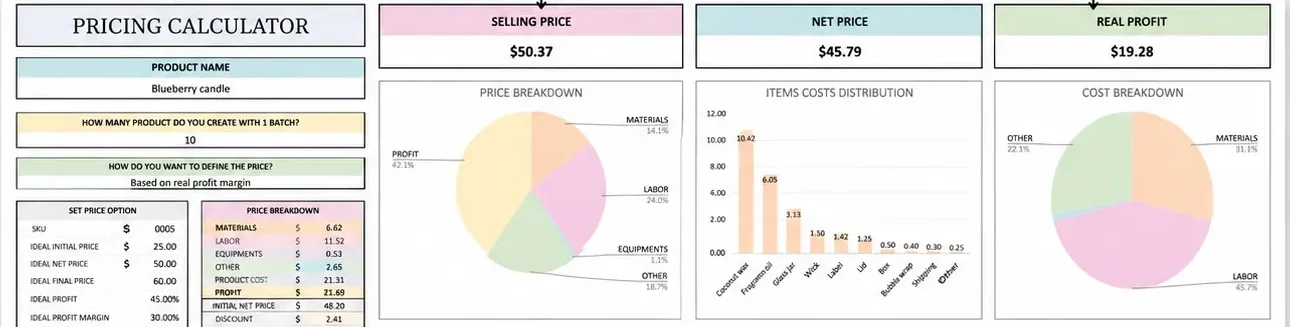
The formula itself is simple, but the slow part is applying it consistently to every product without slipping back into a markup rule. Small Business Bundle is 4 linked spreadsheets with 25+ tabs for Excel 365 and Google Sheets, sold as one instant download.
Its Pricing Calculator has 3 tabs. For each product you enter the batch size and the cost tables for materials, labor, equipment and other costs. You then define the price from a real profit margin, add a discount and sales tax, and read the selling price, net price and real profit.
It is not accounting software or a payment processing service. If you want a pricing calculator that starts from the margin you want to keep, it is a one-time purchase rather than a monthly subscription. For the wider picture, see our small business spreadsheet guide. Excel and Google Sheets are trademarks of their owners, and we are not affiliated with them.
Frequently Asked Questions
What is the difference between markup and margin?
Both measure the same profit, but they divide it by different numbers. Markup divides the profit by what the item cost you, while margin divides the profit by what the customer pays. On a $20 item sold for $30, the profit is $10, so the markup is 50% and the margin is 33.3%.
Is a 50% markup the same as a 50% margin?
No. A 50% markup on a $20 cost gives a $30 price and a 33.3% margin. A 50% margin needs a $40 price, which is a 100% markup. The margin is always the smaller percentage, because the price it is divided by is larger than the cost.
Which one should I use to set prices?
Use margin to decide what you want to keep, because it matches how fees, taxes and discounts work: they are all a share of the price. Markup is acceptable as a quick rule of thumb, provided you know which margin it produces.
How do I turn a markup into a margin?
Divide the markup by 100 plus the markup. A 60% markup gives 60 ÷ 160 = 37.5%. To go the other way, divide the margin by 100 minus the margin: a 40% margin gives 40 ÷ 60 = 66.7% markup.
Can a margin ever be above 100%?
No. Margin is profit as a share of the price, and profit can never be more than the whole price, so 100% is the ceiling. Markup has no ceiling: selling a $20 item for $80 is a 300% markup and a 75% margin.
Do platform fees change the markup or the margin?
They change both, but the margin is where you feel it. A 10% fee takes 10 points straight off your margin. On a $28 price that is $2.80, which turns a 28.6% margin into 18.6%. Check your platform's current fee page for the real rate.
Frequently asked questions
What is the difference between markup and margin?
Both measure the same profit, but they divide it by different numbers. Markup divides the profit by what the item cost you, while margin divides the profit by what the customer pays. On a $20 item sold for $30, the profit is $10, so the markup is 50% and the margin is 33.3%.
Is a 50% markup the same as a 50% margin?
No. A 50% markup on a $20 cost gives a $30 price and a 33.3% margin. A 50% margin needs a $40 price, which is a 100% markup. The margin is always the smaller percentage, because the price it is divided by is larger than the cost.
Which one should I use to set prices?
Use margin to decide what you want to keep, because it matches how fees, taxes and discounts work: they are all a share of the price. Markup is acceptable as a quick rule of thumb, provided you know which margin it produces.
How do I turn a markup into a margin?
Divide the markup by 100 plus the markup. A 60% markup gives 60 ÷ 160 = 37.5%. To go the other way, divide the margin by 100 minus the margin: a 40% margin gives 40 ÷ 60 = 66.7% markup.
Can a margin ever be above 100%?
No. Margin is profit as a share of the price, and profit can never be more than the whole price, so 100% is the ceiling. Markup has no ceiling: selling a $20 item for $80 is a 300% markup and a 75% margin.
Do platform fees change the markup or the margin?
They change both, but the margin is where you feel it. A 10% fee takes 10 points straight off your margin. On a $28 price that is $2.80, which turns a 28.6% margin into 18.6%. Check your platform's current fee page for the real rate.