How to Price Handmade Items So Your Time Is Paid For
How to price handmade items: a $6.83 candle needs a $13.67 price and a $21.50 crochet headband needs $43.00 once your time and fees are counted.
By Small Business Bundle by Cosmo Suite · Editorial policy
Published · 8 min read
To price handmade items, add up four things: materials, your labor, a share of overhead and the wear on your tools. That total is the unit cost, the full cost of making one item. Divide it by one minus the margin you want and the platform fee you pay: price = unit cost ÷ (1 − margin − fee).
Many makers price from the receipt for supplies and then guess at the rest, and the part that quietly goes missing is the one the maker supplies, which is the hours. A price that leaves out your time gives that time to the customer, and you pay for it.
Below, one candle and one crochet headband are priced step by step, with every calculation shown, so that you can substitute your own numbers and see the profitability of each item.
In Short: count materials, paid time, overhead and fees, then divide. If the result looks unreasonably high, adjust the inputs before you reduce your own wage.
One Candle and One Headband, Priced Step by Step
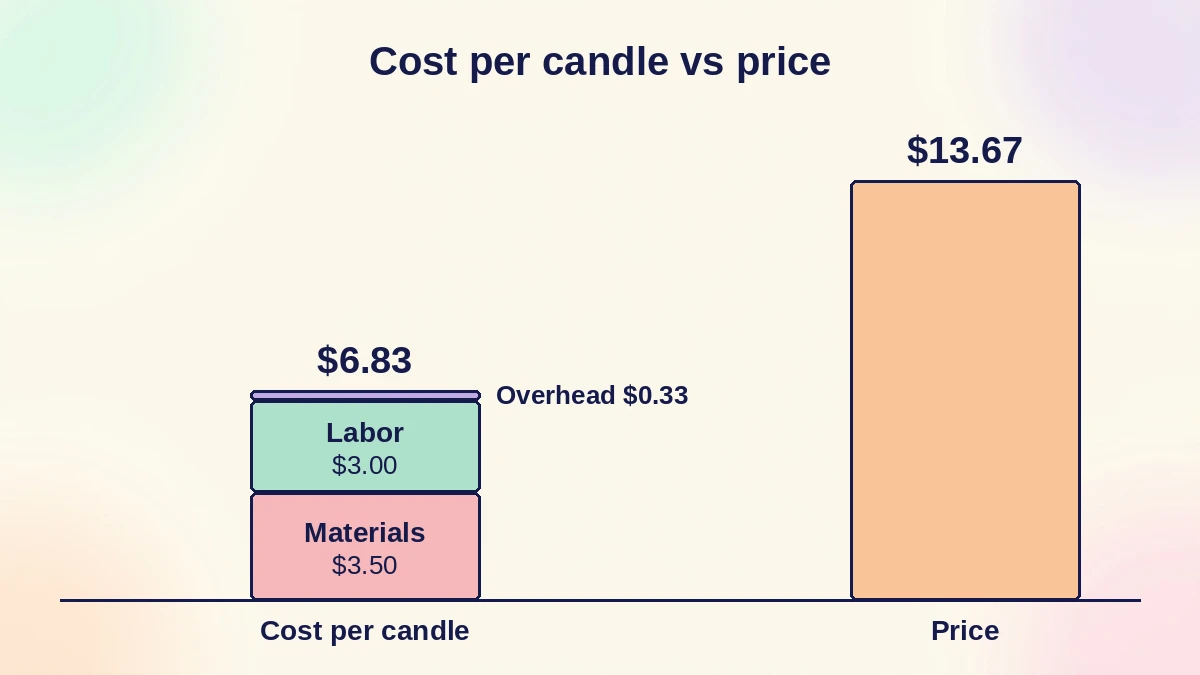
A batch of 12 soy candles that costs $82.00 to make works out at $6.83 a candle. The price that earns a 40% margin after a 10% platform fee is $13.67. The figures are made up, so replace them with yours.
| Cost group | What goes in | Per batch of 12 | Per candle |
|---|---|---|---|
| Materials | Wax $14.40, fragrance $7.20, 12 tins $15.00, wicks $3.00, labels $2.40 | $42.00 | $3.50 |
| Labor | 2 hours at $18 an hour | $36.00 | $3.00 |
| Overhead | $480 a year ÷ 240 making hours = $2.00 an hour, for 2 hours | $4.00 | $0.33 |
| Unit cost | $82.00 | $6.83 |
Materials are $3.50, which is approximately half of the total production cost. Doubling the materials gives $7.00, a price only 17 cents above cost. A 10% fee takes 70 cents of it, so each candle sold at $7.00 loses 53 cents.
The appropriate price works backward from the margin you intend to keep. With a 40% margin and a 10% fee, the unit cost must fit in the other 50% of the price: $6.83 ÷ (1 − 0.40 − 0.10) = $6.83 ÷ 0.50 = $13.67. Verify it in the forward direction: the fee is $1.37, the profit is $13.67 − $6.83 − $1.37 = $5.47, and $5.47 ÷ $13.67 is 40%.
The crochet headband follows the same calculation with smaller numbers: yarn and a button at $5.00, one hour at $15, and overhead at $1.50 an hour. The unit cost is $5.00 + $15.00 + $1.50 = $21.50, and the price is $21.50 ÷ 0.50 = $43.00. The Maker's Business Toolkit gives the same build-up: materials, labor at hours times an hourly rate, overhead, equipment and profit.
Use it when: you have only ever priced from the cost of supplies.
Where the Time Goes: Labor and Overhead
Labor is the hours an item takes multiplied by an hourly rate you would accept as pay, while overhead is the cost of running the business, spread across those same hours. Together they are often more than half of a handmade unit cost, and they are the two lines that makers most commonly skip.
Labor: time one real batch
Time the whole job, from setting out the tools to boxing the order. Use a rate you would realistically accept from an employer for that particular skill. A candle batch that takes 2 hours at $18 costs $36.00, or $3.00 a candle. Count the administrative parts too, such as labelling, photographing and packaging.
Use it when: you have never timed a batch from start to packed box.
Overhead: a rate per making hour
Add up a full year of general business expenses that no single item owns, such as a website, a craft-fair registration fee or a workspace share. In the example that is $480. Divide by the hours you really spend making, $480 ÷ 240 = $2.00, and add that rate for every hour an item takes. The IRS lists direct labor, materials and supplies, and other costs as parts of the cost of goods sold. Those other costs include containers and overhead expenses. Your tax form counts the same lines your price should.

Use it when: your price covers the wax but not the website or the booth.
What the Hourly Rate Does to a $5 Headband
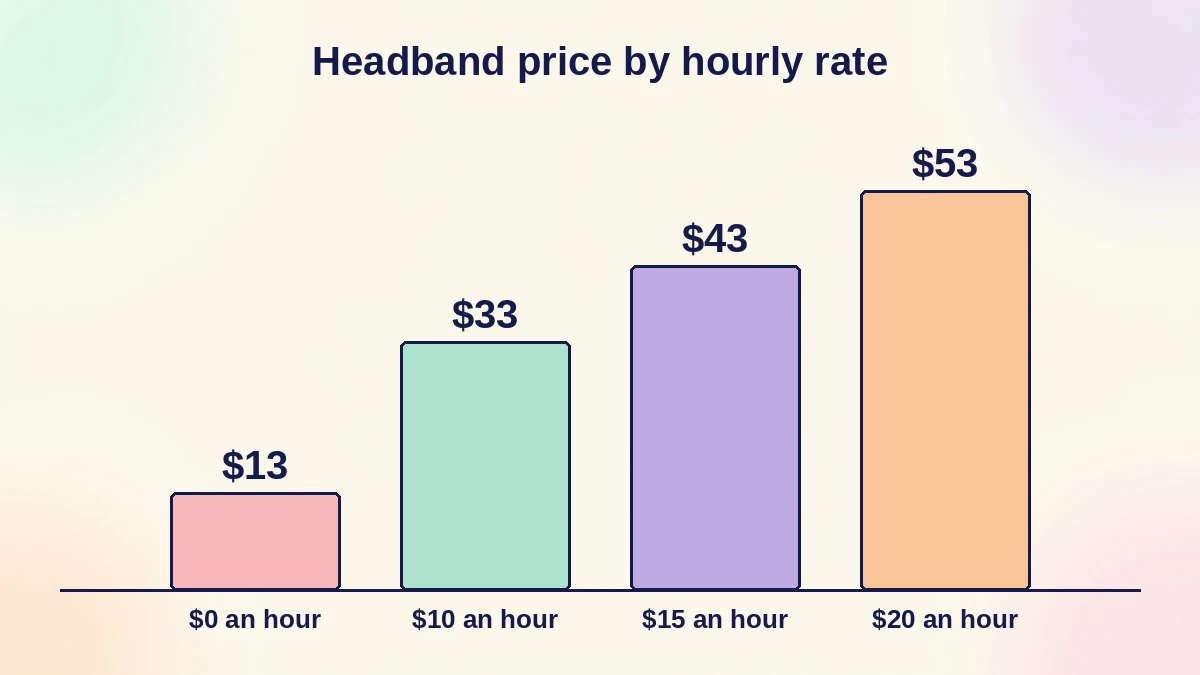
The hourly rate influences the final price more than any other individual input. Here is the headband priced at four rates, with materials at $5.00 and overhead at $1.50 for the hour, always at a 40% margin and a 10% fee.
| Your rate | Unit cost | Price | Time paid per item |
|---|---|---|---|
| $0 an hour | $6.50 | $13.00 | $0.00 |
| $10 an hour | $16.50 | $33.00 | $10.00 |
| $15 an hour | $21.50 | $43.00 | $15.00 |
| $20 an hour | $26.50 | $53.00 | $20.00 |
The $13.00 row looks attractive to buyers, but it pays you nothing for the hour of work behind it. Going from $0 to $15 an hour moves the price by $30.00, and almost all of that difference is your time. Whether buyers will actually accept $43.00 is a separate question, and the next section covers it.
Use it when: your price feels high and you want to know which line made it so.
What to Do When the Price Looks Too High
The formula price is the lowest price that works for you, and buyers may still decline it. Compare it with comparable items from other sellers. Then change the inputs in this order:
- Cut the time. Eliminate unnecessary steps and combine the repetitive ones, and make 12 candles instead of 6, because preparation time is shared across the whole production run.
- Buy in bulk. A lower cost per jar or per skein of yarn improves the margin on every production batch.
- Sell a set. Three headbands in one package increase the order value without tripling the packaging time.
- Choose a different item. If an item cannot generate a reasonable wage at any price that customers accept, produce fewer of them.
Lowering your own wage comes last, because working for $4 an hour over a long period tends to end in burnout and not in a bigger customer list.
Redoing these sums by hand for every item, and again every time a supply price changes, is slow and easy to get wrong. A pricing sheet where each product keeps its own cost tables turns the whole routine into a single adjustment.
Why Trust This Article
We are the Cosmo Suite team that built Small Business Bundle, so we have an interest in you using a spreadsheet. The build-up of the price comes from The Maker's Business Toolkit and the cost categories from IRS Publication 334, both read on 8 October 2026. Methodology: the candle batch and the headband are made up, and we checked every total by hand, for example $42.00 + $36.00 + $4.00 = $82.00. They are not customer results. Our editorial policy explains how we write, and about us says who we are and how to contact us. This is general information, not tax or financial advice, so check your own numbers.
How Small Business Bundle Handles This
The slow part of pricing is repeating the same sums for every product. Small Business Bundle is 4 linked spreadsheets with 25+ tabs for Excel 365 and Google Sheets, sold as one instant download.
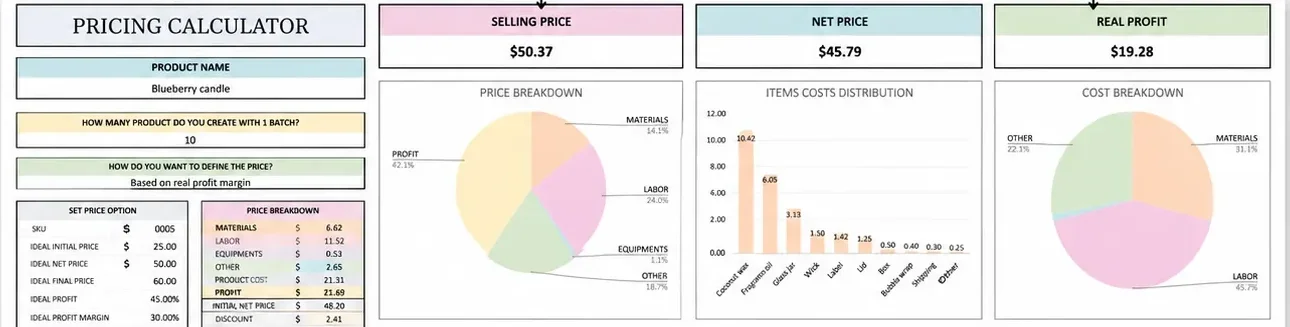
Its Pricing Calculator has 3 tabs. For each product you enter the batch size and the cost tables for materials, labor, equipment and other costs. You then define the price from a real profit margin, add a discount and sales tax, and read the selling price, net price and real profit. For the full walk-through, see how to price a product from materials, labor and fees.
It is not accounting software or a payment processing service. If you want a pricing calculator for every handmade item you sell, in one file you own, it is a one-time purchase rather than a monthly subscription. For the wider picture, see our small business spreadsheet guide. Excel and Google Sheets are trademarks of their owners, and we are not affiliated with them.
Frequently Asked Questions
What is the simplest formula to price handmade items?
Add materials, your labor, a share of overhead and any equipment wear to get a unit cost. Then divide that cost by one minus the profit margin and the platform fee you expect. A $6.83 candle with a 40% margin and a 10% fee becomes $6.83 ÷ 0.50 = $13.67.
How much should I pay myself per hour?
Pick a rate you would accept from an employer for the same skill, and use it on every item. The example here uses $18 an hour for candles and $15 for crochet. Paying yourself $0 an hour does not remove the cost of your time. It just hides it.
Is doubling the cost of materials enough?
Usually not. Materials were only $3.50 of the $6.83 candle cost, so doubling them gives $7.00. After a 10% fee that price loses 53 cents on every candle. Doubling works only when materials are most of your cost.
What if my price is higher than what similar items sell for?
Change the inputs before you change the wage. Look for faster steps, cheaper bulk materials, a bigger batch or a design that sells for more. If none of that closes the gap, sell a different item or a larger set.
What is overhead, and do I need it?
Overhead is a cost of running the business that is not tied to one item, such as a website, a booth fee or a workspace share. Add a year of it, divide by your making hours, and charge that rate for each hour an item takes.
How often should I update my prices?
Update them whenever a material, fee or hourly rate changes, and review all of them at least once a year. In a spreadsheet you change one cell and every price follows, so the review takes minutes.
Frequently asked questions
What is the simplest formula to price handmade items?
Add materials, your labor, a share of overhead and any equipment wear to get a unit cost. Then divide that cost by one minus the profit margin and the platform fee you expect. A $6.83 candle with a 40% margin and a 10% fee becomes $6.83 ÷ 0.50 = $13.67.
How much should I pay myself per hour?
Pick a rate you would accept from an employer for the same skill, and use it on every item. The example here uses $18 an hour for candles and $15 for crochet. Paying yourself $0 an hour does not remove the cost of your time. It just hides it.
Is doubling the cost of materials enough?
Usually not. Materials were only $3.50 of the $6.83 candle cost, so doubling them gives $7.00. After a 10% fee that price loses 53 cents on every candle. Doubling works only when materials are most of your cost.
What if my price is higher than what similar items sell for?
Change the inputs before you change the wage. Look for faster steps, cheaper bulk materials, a bigger batch or a design that sells for more. If none of that closes the gap, sell a different item or a larger set.
What is overhead, and do I need it?
Overhead is a cost of running the business that is not tied to one item, such as a website, a booth fee or a workspace share. Add a year of it, divide by your making hours, and charge that rate for each hour an item takes.
How often should I update my prices?
Update them whenever a material, fee or hourly rate changes, and review all of them at least once a year. In a spreadsheet you change one cell and every price follows, so the review takes minutes.
Sources
Keep reading
Pricing Your Products
Product Pricing Calculator: Materials, Labor, Fees and Margin in One Sheet
Product pricing calculator: price one candle from materials, labor, equipment, packaging and fees. A $7.85 unit cost becomes a $15.70 price at a 40% margin.
· 9 min read
Pricing Your Products
Markup vs Margin: The Difference That Quietly Costs Small Sellers Money
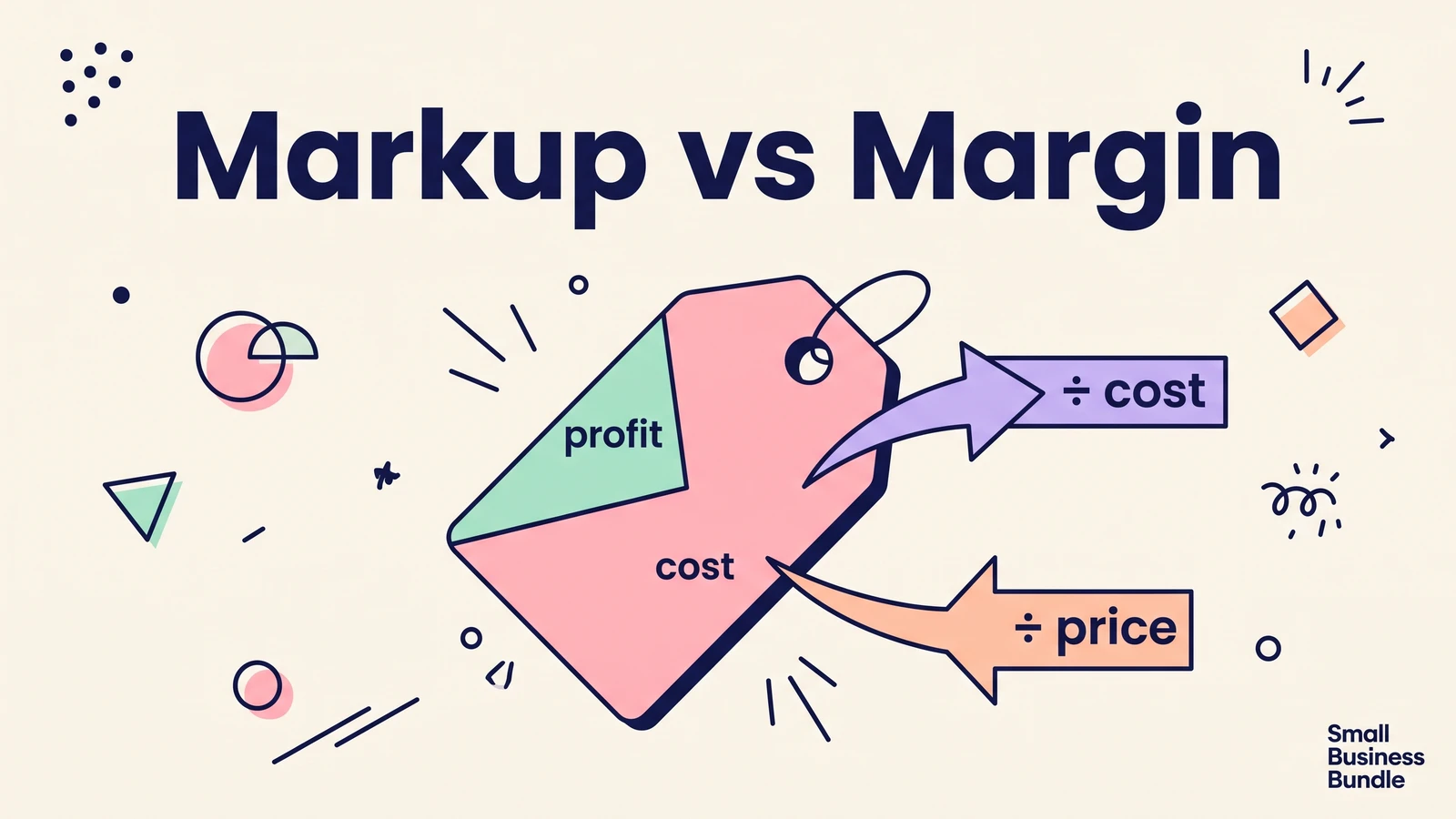
Markup vs margin: a 40% markup on a $20 item is only a 28.6% margin. See the table, the two conversion formulas and the price that really earns 40%.
· 8 min read