Cake Pricing Calculator: Ingredients, Hours and Boxes in One Price
Cake pricing calculator: price an 8-inch cake by counting ingredients, labor, packaging and marketplace fees in a worked example you can adjust.
By Small Business Bundle by Cosmo Suite · Editorial policy
Published · 8 min read

A cake pricing calculator helps you turn a recipe and a work session into a price you can explain. Count the ingredients that went into one cake, pay for the hours you spent making it, add the box and board, then account for fees from the place where you sell it.
An 8-inch cake can look affordable when you count only flour, sugar and eggs. The number changes when you include the baker’s time and the packaging that protects the finished cake. This guide works through one clearly fictional example, shows where marketplace fees fit, and gives you a repeatable way to check your own prices. If you price more than cakes, the product pricing calculator guide covers a broader set of handmade goods.
For a wider view of how a spreadsheet can handle day-to-day seller tasks, see the small business spreadsheet guide.
Key takeaways: Use the cost for one finished cake, count your work time, and choose a margin before setting the price. Treat each selling platform’s fees separately, because transaction, payment processing and listing charges may use different bases.
What does a cake pricing calculator need?
A useful cake pricing calculator needs four inputs: ingredients, labor, packaging and any channel fees that apply to the sale. Its first job is to show the cost of making one cake. Then it can calculate a price from the margin you choose.
| Input | What to count | Example for one 8-inch cake |
|---|---|---|
| Ingredients | The portion of each ingredient used | $10.80 |
| Labor | Time spent on the order multiplied by an hourly rate | $50.00 |
| Packaging | Box, board and other items sent with the cake | $3.60 |
| Cost before selling fees | Ingredients + labor + packaging | $64.40 |
These figures are made up for the example. Replace them with your own recipe quantities, receipts, work time and packaging costs. The Small Business Bundle Price Setter is one spreadsheet option for keeping product costs together when you sell more than one kind of item.
The calculator should keep cost and price separate. Cost describes what you spend to produce the order. Price is what you charge the customer. A price that covers the grocery receipt may still leave out your labor and packing materials.
How do you calculate a cake price from cost?
First total the cost of one cake. Then divide by one minus your target margin. If you sell through a marketplace, account for the applicable percentage fee in the denominator as well.
For this example, the cake costs $64.40 before selling fees, and the target margin is 40%. Without a platform fee, the calculation is:
$64.40 ÷ (1 − 0.40) = $107.33
Suppose the sale is on Etsy and you are including its 6.5% transaction fee. The fee is applied to the order amount, so the example price needs to leave room for that percentage too:
$64.40 ÷ (1 − 0.40 − 0.065) = $120.37
At $120.37, the example’s transaction fee is about $7.82. Subtracting that fee and the $64.40 production cost leaves about $48.15, or 40% of the sale price. The calculation only models the Etsy transaction fee. Etsy lists payment processing, listing, advertising and other fees separately, and some of those vary by country or order. Check the current Etsy fees and taxes page before using a rate in your own price.
This worked example models the Etsy transaction fee alone. It leaves out payment processing, possible advertising charges, tax, delivery and any other fees that apply to a particular shop or order.

Why Trust This Article
The cake figures are illustrative, and the arithmetic is shown so you can replace each input. Marketplace fee details link to Etsy's current help page; the note about home-based food rules points to FDA guidance. The Small Business Bundle editorial policy explains how the site handles sources and corrections.
Which cake costs are easy to miss?
The easy-to-miss costs are the small amounts that repeat: decoration supplies, a cake board, supports, a box, labels and time spent on custom details. List what the buyer receives and the work needed to make it before calculating a price.
Ingredients: cost the amount used
Use the quantity that goes into the recipe, not the full price of every package you bought. If a bag of flour costs $4 and the recipe uses one quarter of it, the example assigns $1 to that cake. Do the same for butter, sugar, eggs, filling, frosting and decorations.
For custom orders, note any ingredient that is specific to the design or flavor. A topper, fruit filling or specialty chocolate can move the cost enough to change the final price. Keep the amounts tied to your own receipts; grocery prices vary by shop and location.
Labor: count the whole job
Choose an hourly rate for the example and multiply it by the time you actually spend. Include the work that belongs to the order, such as mixing, baking, cooling, leveling, filling, decorating, cleaning tools used for that cake and packing it for pickup.
Here, the example uses 2.5 hours at $20 per hour, which equals $50. That is an illustration, not a recommended wage or a claim about typical baking time. If you make several cakes in one batch, separate shared setup time from the time for each cake and explain how you split it.
Packaging: include what leaves with the customer
Add the cake board, box, dowels or supports, ribbon and any other packing item used for the order. For bulk supplies, divide the purchase cost by the number of usable pieces. If a large cake needs a stronger board or a taller box, use those costs for that cake instead of applying a single package amount to every size.

How should marketplace fees change the price?
Model fees from the platform’s current terms and use the fee’s actual base. A percentage charged on the order total behaves differently from a fixed listing charge or a payment fee that varies by country.
Etsy’s U.S. help page currently lists a 6.5% transaction fee on the total order amount, including shipping and gift wrap when charged. It also lists a $0.20 listing fee and explains that payment processing fees vary by country. Those charges do not all work the same way, so avoid combining them into one guessed percentage. Record the fee types that apply to your shop, then calculate each against the right amount.
The $120.37 example includes the 6.5% transaction fee only. If you want a fuller estimate, add the other relevant fees to the model using their current terms. If you use Etsy Offsite Ads for an order or pay for currency conversion, those charges can change what remains from the sale. Recheck the fee page when Etsy changes its terms.
For direct orders, use the payment processor or payment method you actually accept. Avoid adding a generic card rate unless it matches your account and transaction. A cash pickup, a card payment and a marketplace sale may have different costs.
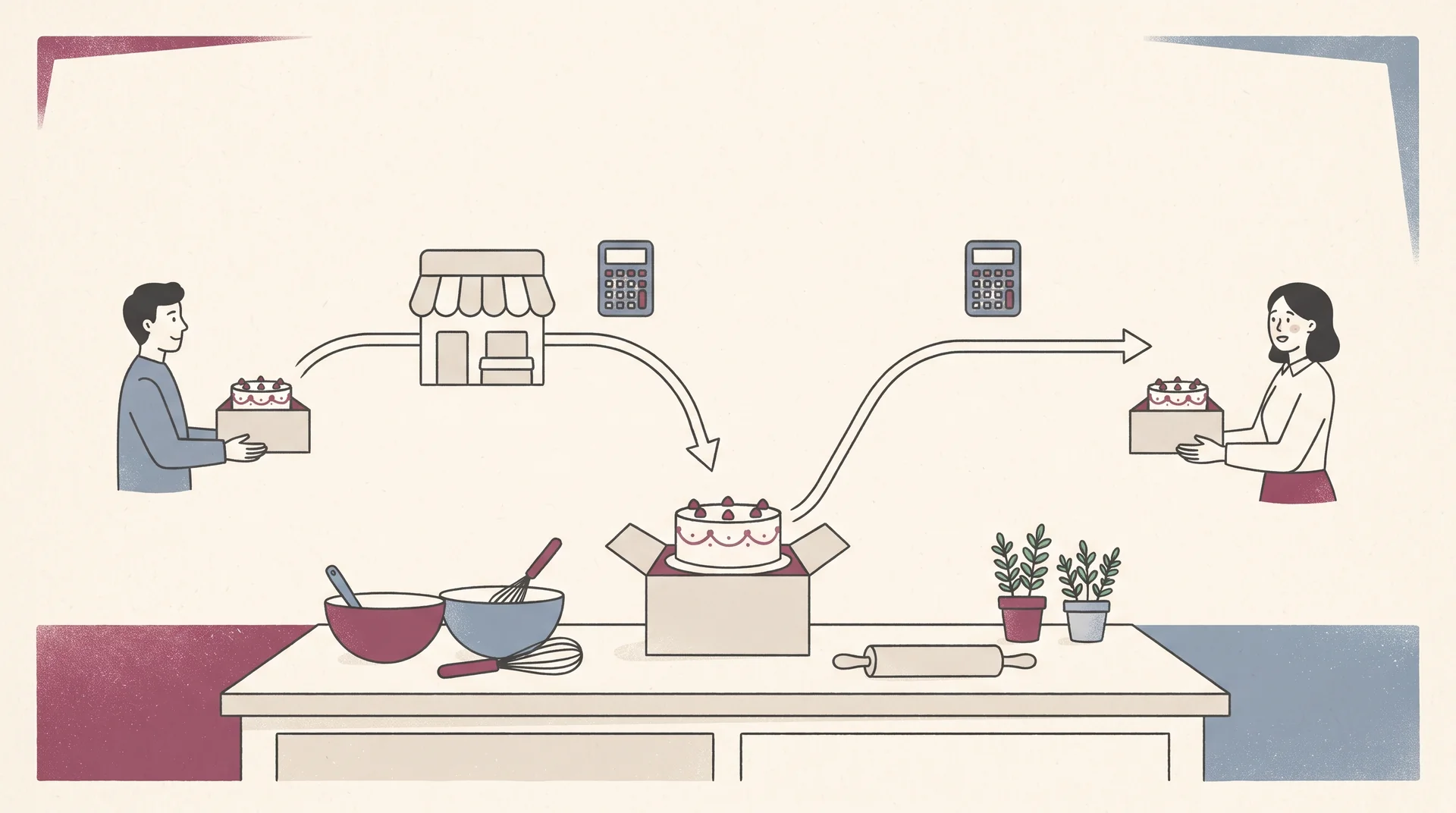
Does “ingredients times three” work for cake pricing?
Cake unit cost is the total cost of making one finished cake, including ingredients, labor and packaging. Multiplying ingredients by three can miss two of those costs. In the fictional example, ingredients are $10.80, so the shortcut gives $32.40. That is $32.00 below the $64.40 production cost before any selling fee is counted.
The shortcut is easy to remember, but it does not know how long a custom cake takes or whether it needs a special box and board. A simple cake and an intricate decorated cake may use similar base ingredients while requiring very different work. Let the cost list carry those differences.
If the calculated price feels too high for the customers you want to reach, use that as a business decision point. Check whether the recipe, decoration time, order size, delivery, or selling channel can change. You can also compare similar cakes in your area, while keeping their size and finish in mind. A competitor’s price can inform the decision, but it cannot tell you whether your own cost is covered.
When you are comparing a wholesale order with a direct sale, use separate calculations for each channel. The wholesale versus retail price guide explains how the buyer and selling arrangement change the math.
When should you change a cake price?
Recalculate when an ingredient, package, fee or work step changes enough to affect the result. Keep the old and new inputs so you can see why the price moved.
If butter costs more, change the amount used for the cake rather than raising every product by the same amount. If a custom design adds an hour, add that labor. If the box changes, update the packaging line. If a platform changes a fee, revise the fee input and check whether the new price still fits the market you serve.
The U.S. Small Business Administration describes break-even as the point where total cost and total revenue are equal. That is useful context when checking whether an order price is simply covering cost or contributing toward other business expenses. The SBA business planning guide can help you consider costs and pricing as part of a wider plan.
This calculation is a planning aid, not tax, legal or food safety advice. Home-based food rules depend on where and how you sell. The FDA guide to starting a food business directs home-based businesses to check FDA requirements and state and local health department rules.
What does Small Business Bundle add to the process?
Small Business Bundle includes a pricing spreadsheet, the Price Setter, among its four linked spreadsheets. Its Price Setter has three tabs. You can use it to keep product costs and pricing inputs together; it does not take cake orders, process payments or replace local food-business guidance.
The bundle is one option if you already work in Excel 365 or Google Sheets and want a file you can update. The homepage describes the included spreadsheets and their limits.
Write down one cake’s ingredient amounts, the time it takes, the package that goes with it and the fees for the place you sell it. A calculator can turn those inputs into a repeatable price, but the inputs need to match the order.
The example started with a $64.40 cost and reached $120.37 after allowing for a 40% margin and Etsy’s 6.5% transaction fee. Your recipe, labor, market and platform terms will produce a different result. Keep the calculation where you can update it, and check the price again when one of those inputs changes.
If you want to compare several products in one place, Small Business Bundle includes the Price Setter alongside its Orders & Customers Log, Business Bookkeeping Ledger and Business Bill Due Calendar. The bundle does not include an online store or payment processing.
Frequently asked questions
How do I price a homemade cake?
Add the ingredients used, your hands-on labor, packaging and any selling fees. Divide that total cost by the number of cakes, then use your target margin to calculate a selling price. Check the result against local prices and your own business needs.
How much should I charge for an 8-inch cake?
There is no single price for every 8-inch cake. Size alone leaves out the recipe, decoration, labor, packaging and selling channel. Cost one specific cake first, then compare the calculated price with similar cakes in your market.
Should I charge for my time when baking cakes?
Yes. Count the time you spend shopping for a custom order when relevant, preparing, baking, decorating and packing. Choose an hourly rate for your example, then divide the labor cost across the cakes produced.
How do I include Etsy fees in a cake price?
Use Etsy's current fee page and include the fees that apply to your shop and order. Its transaction fee is separate from payment processing, listing, advertising and other charges. Check each fee's basis before using it in your calculation.
What is the difference between markup and margin for cake pricing?
Markup is the increase over your cost, while margin is the share of the sale price left after cost. They use different bases, so the same percentage gives different prices. Work from the margin formula when you have a target share of the selling price.
Do I need to include the cake box in my price?
Include the box, board, supports and other packaging you use for that order. If a supply is bought in bulk, divide its cost by the number of usable units so the example reflects one cake.
Sources
Keep reading
Pricing Your Products
Product Pricing Calculator: Materials, Labor, Fees and Margin in One Sheet
Product pricing calculator: price one candle from materials, labor, equipment, packaging and fees. A $7.85 unit cost becomes a $15.70 price at a 40% margin.
· 9 min read

Pricing Your Products
Wholesale vs Retail Price: How to Set Both Without Losing Money on Either
Wholesale vs retail price: see what each price covers, test the keystone rule on a worksheet example, and check that both leave room for costs.
· 8 min read

Pricing Your Products
How to Price Crochet Items: Yarn, Hours and a Price People Pay
How to price crochet items: a fox amigurumi works out at $89.20 and a throw blanket at $607.30 once yarn, paid hours, fees and margin are counted.
· 9 min read
