How to Price Crochet Items: Yarn, Hours and a Price People Pay
How to price crochet items: a fox amigurumi works out at $89.20 and a throw blanket at $607.30 once yarn, paid hours, fees and margin are counted.
By Small Business Bundle by Cosmo Suite · Editorial policy
Published · 9 min read
To price crochet items, add the yarn and small components you used, the number of hours you worked at an hourly rate you set, and your fees. Then divide that total cost by what is left of the price after your margin and fees: price = cost ÷ (1 − margin − fee).
Most pricing rules fail crochet in the same place. They count the yarn and shrug at the hours, yet hours are the largest single component of a crocheted item, and a price which leaves them out hands that work to the buyer for free. This guide prices two made-up pieces, a fox amigurumi and a throw blanket, and then tests the popular shortcuts on both. If you want one file that keeps every product's costs in one place, a spreadsheet can do the sums.
In Short: the bottom line is to time your real hours, pay them at a rate you picked, add fees, then divide. Check the result against similar listings by looking at the hourly pay it leaves, not by guessing.
How to Price Crochet Items: Two Worked Examples
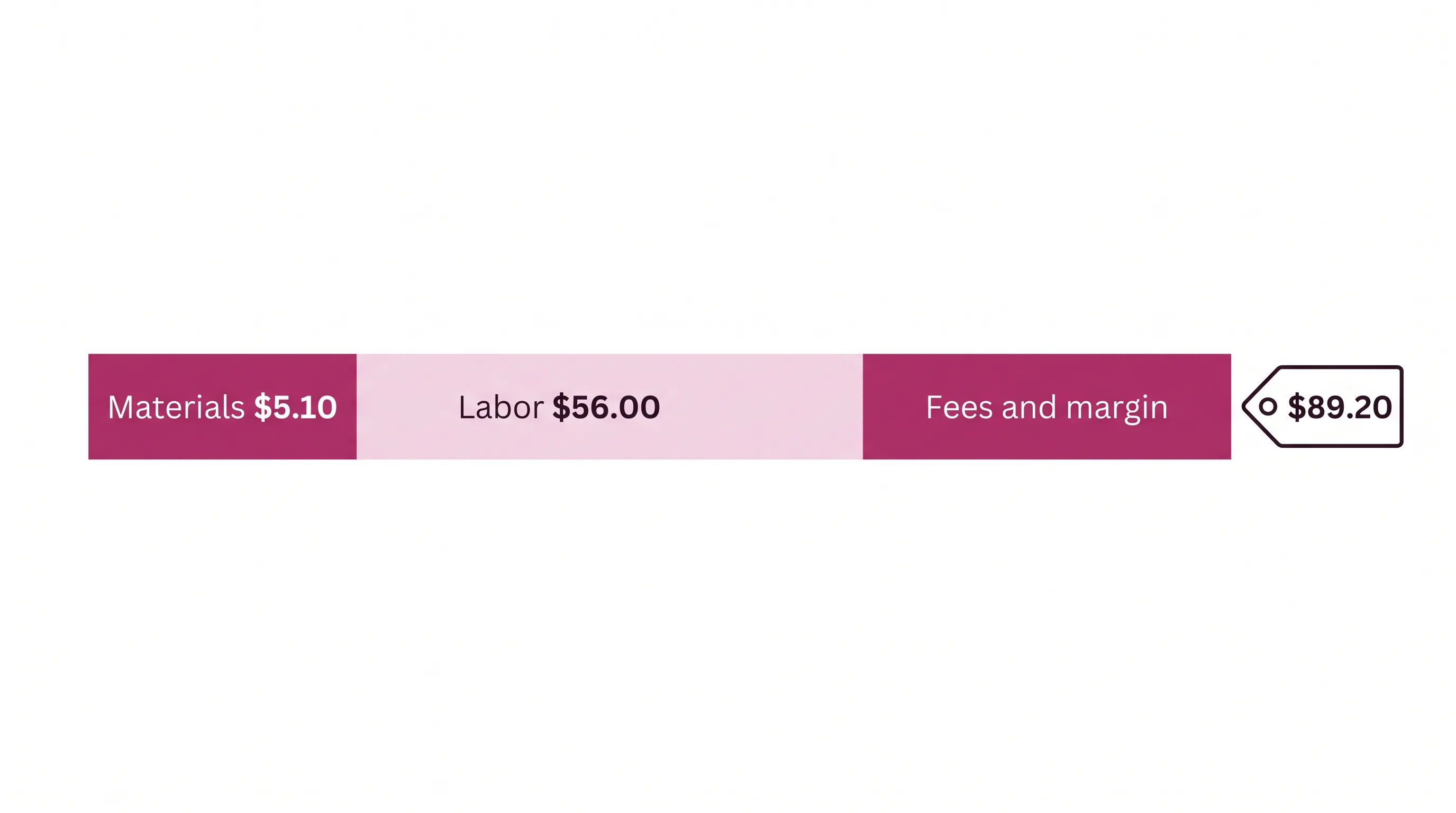
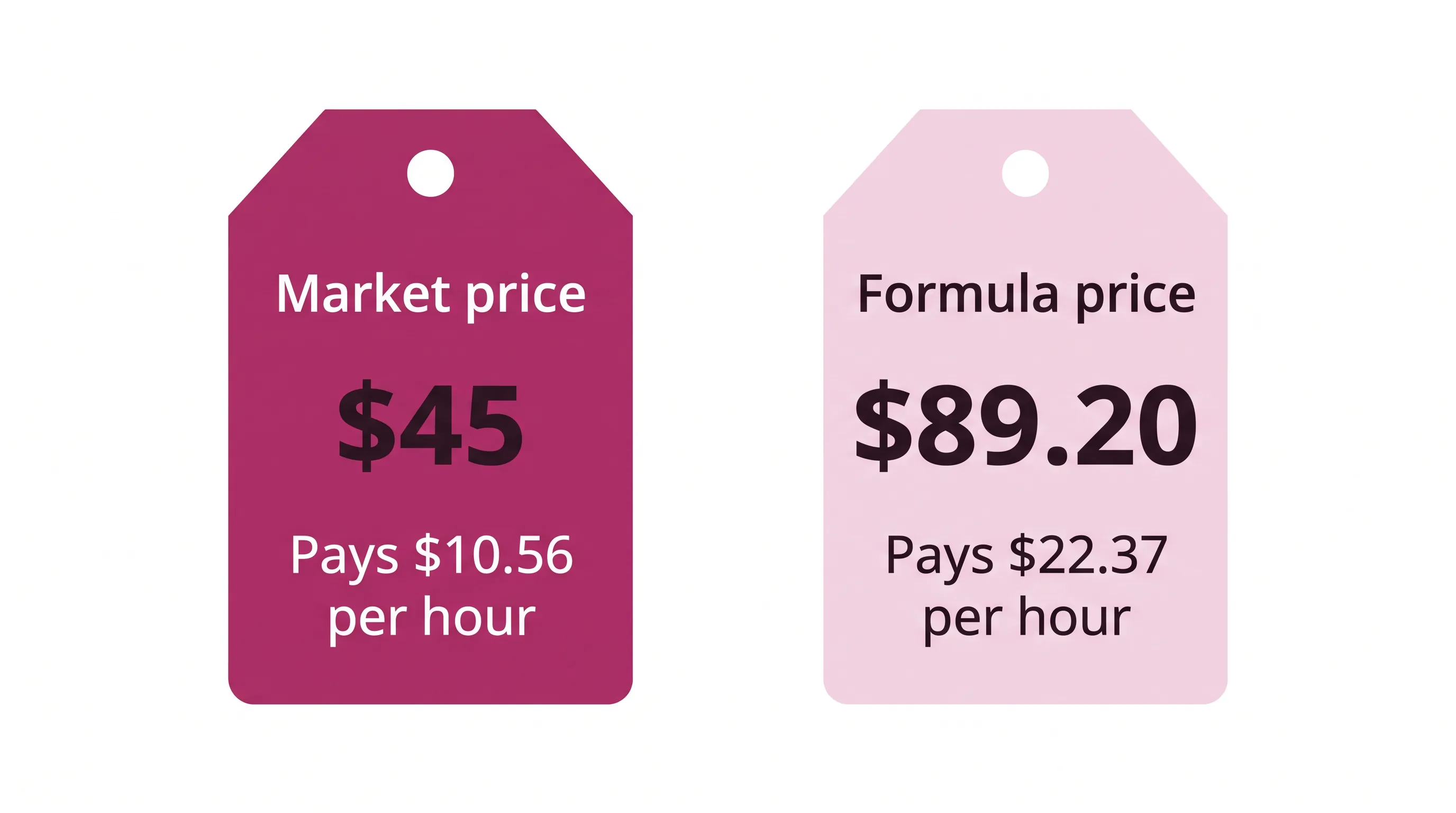
The fox needs $5.10 of materials and 3.5 hours of work. The blanket needs $64.00 of materials and 22 hours. At $16 an hour, a 25% margin and a 6.5% fee, the fox is priced at $89.20 and the blanket at $607.30. Every figure here is invented for illustration, so substitute your own measurements.
| Line | Fox amigurumi | Throw blanket |
|---|---|---|
| Yarn | $3.60 (60% of a $6.00 skein) | $63.00 (7 skeins at $9.00) |
| Stuffing, eyes, packaging and tag | $1.50 | $1.00 |
| Materials | $5.10 | $64.00 |
| Labor | 3.5 hours × $16 = $56.00 | 22 hours × $16 = $352.00 |
| Cost | $61.10 | $416.00 |
| Price = cost ÷ 0.685 | $89.20 | $607.30 |
The divisor is 0.685, which comes from 1 − 0.25 − 0.065. The price must cover your cost, the 6.5% fee and a 25% profit, so the cost fits in the remaining 68.5%. Verify the fox calculation in the forward direction. The fee is $89.20 × 0.065 = $5.80, the profit is $89.20 − $61.10 − $5.80 = $22.30, and $22.30 ÷ $89.20 is 25%.
For the blanket, the fee is $39.47 and the profit is $151.83, which is again 25% of $607.30. However, notice that the blanket's yarn is about 15% of its cost, while the fox's is about 6%. The more hours an item takes, the less its yarn tells you about its price. For example, a second blanket in cheaper yarn would barely move the total, while one more hour of work moves it by $23.36 (16 ÷ 0.685).
Because the divisor sits under the whole cost, any change in margin or fees moves the final price noticeably. Increasing the margin target from 25% to 30%, for instance, changes the divisor from 0.685 to 0.635 and the fox from $89.20 to $96.22, since $61.10 ÷ 0.635 is $96.22. Recalculating one particular cell in a spreadsheet is far faster than redoing every item by hand.
The 6.5% is one sample rate, not a statement about your particular shop. Etsy lists several fees, and they apply to different amounts, so read the current Etsy fees page and enter the particular charges you actually incur.
Use it when: you have a finished piece and a notebook of hours, and you need one number.
Which Pricing Shortcuts Pay Your Hours?
A pricing shortcut is a one-line rule that skips the cost build-up, and it is worth using only if it leaves you the hourly pay you want. Test each one by computing what you take home per hour: price, minus the fee, minus materials, divided by hours. That figure includes your profit, so it can sit above your $16 rate.
Two shortcuts are mentioned constantly in online crochet communities. One is materials × 3, which a Reddit thread on crochet pricing lists among other formulas. The other is a flat multiplier: Crochetpreneur's balanced method multiplies materials, labor and business expenses by 1.75 for a retail price. We omitted business expenses to keep the comparison straightforward.
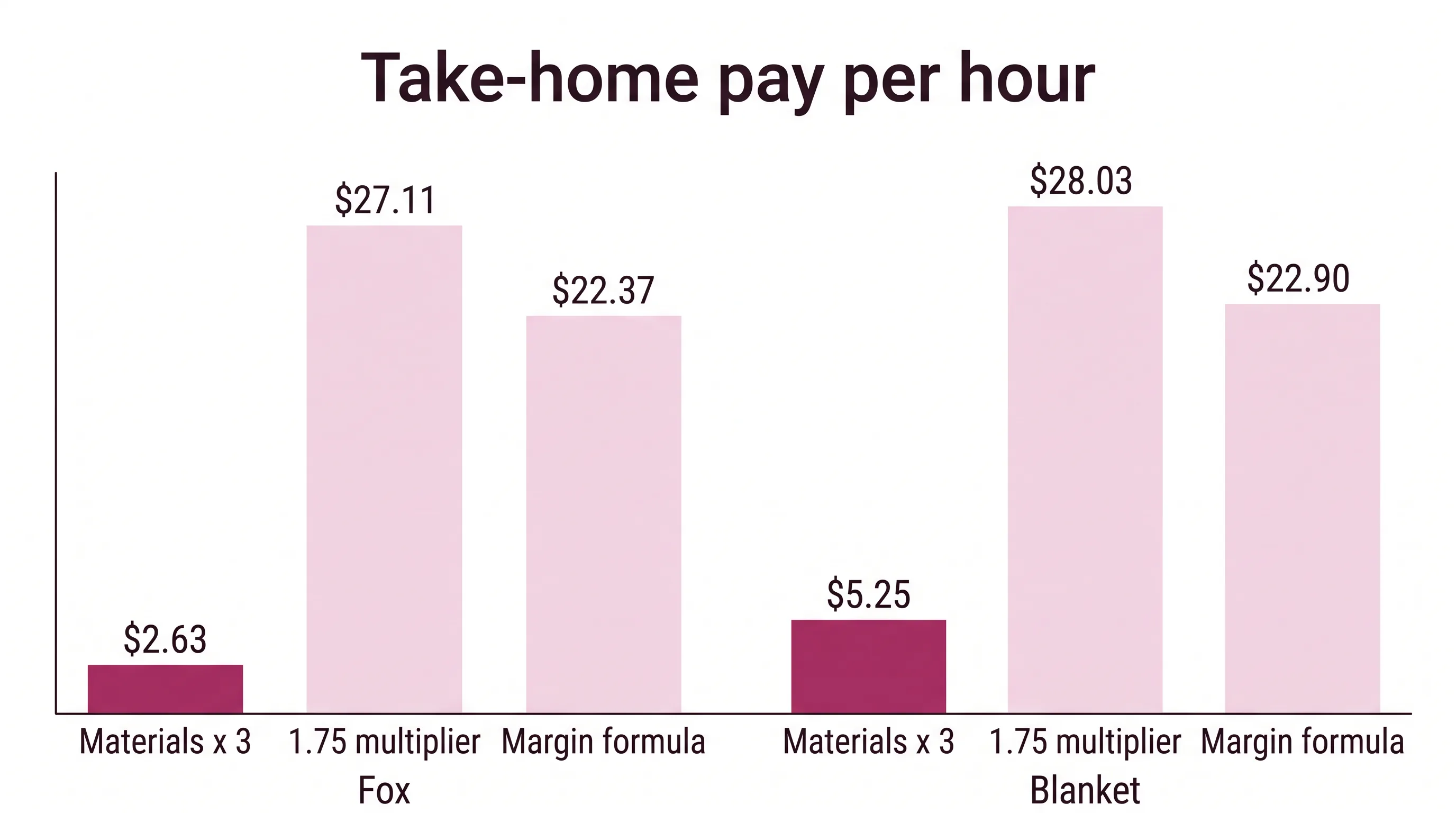
| Method | Fox price | Fox pay per hour | Blanket price | Blanket pay per hour |
|---|---|---|---|---|
| Materials × 3 | $15.30 | $2.63 | $192.00 | $5.25 |
| 1.75 × (materials + labor) | $106.92 | $27.11 | $728.00 | $28.03 |
| Margin formula from above | $89.20 | $22.37 | $607.30 | $22.90 |
Therefore materials × 3 is the clear loser. It prices the fox at $15.30, which produces approximately $2.63 an hour after the fee and the materials. Tripling the yarn takes no account of the 3.5 hours of work behind the finished animal. The multiplier on materials and labor does not lose money here, and it pays $27 an hour on the fox. However, it is tied to nothing you chose. It ignores your margin target and your fee, so it can be too high to sell or, with a heavier fee, too low.
A multiplier can still be a reasonable first estimate when you have no time to build the full cost, particularly for quick, inexpensive pieces. Check it once against a properly timed item, so that you know what hourly compensation it actually produces before you apply it to a whole catalog.
Use it when: a friend recommends a rule, and you want to see what hourly pay it leaves you before you copy it.
Which Crochet Costs Are Easy to Miss?
The costs that makers overlook are individually small and repeated constantly: part of a skein, safety eyes, the bag, and the hours that never feel like crochet. Document each one for one finished item, preferably while the details are still fresh. A short list maintained beside the finished piece is considerably more reliable than a number remembered afterwards.
Yarn: Count the Part You Used
Measure whatever remains of the skein, or count the rows it covered, and charge only for the portion that was actually used. If 60% of a $6.00 skein went into the fox, the fox carries $3.60. The remaining 40% belongs to the next project. For the blanket, 7 whole skeins at $9.00 give $63.00, since the 22 hours use them all.
Use it when: you have a partly used skein on your table and do not know what to charge.
Small Parts and Packaging
Eyes, stuffing, buttons, a tag and a bag each cost a little. In the fox example, 60 cents of stuffing, 40 cents of eyes and 50 cents of packaging added $1.50. Purchase components in bulk, then divide the total expenditure by the number of individual pieces you receive. A $6.00 pack of 30 eyes costs $0.20 each, or $0.40 a pair. These small amounts add up considerably because every sale repeats them.
Use it when: your price list leaves out everything that is not yarn.
Hours: Time the Whole Job
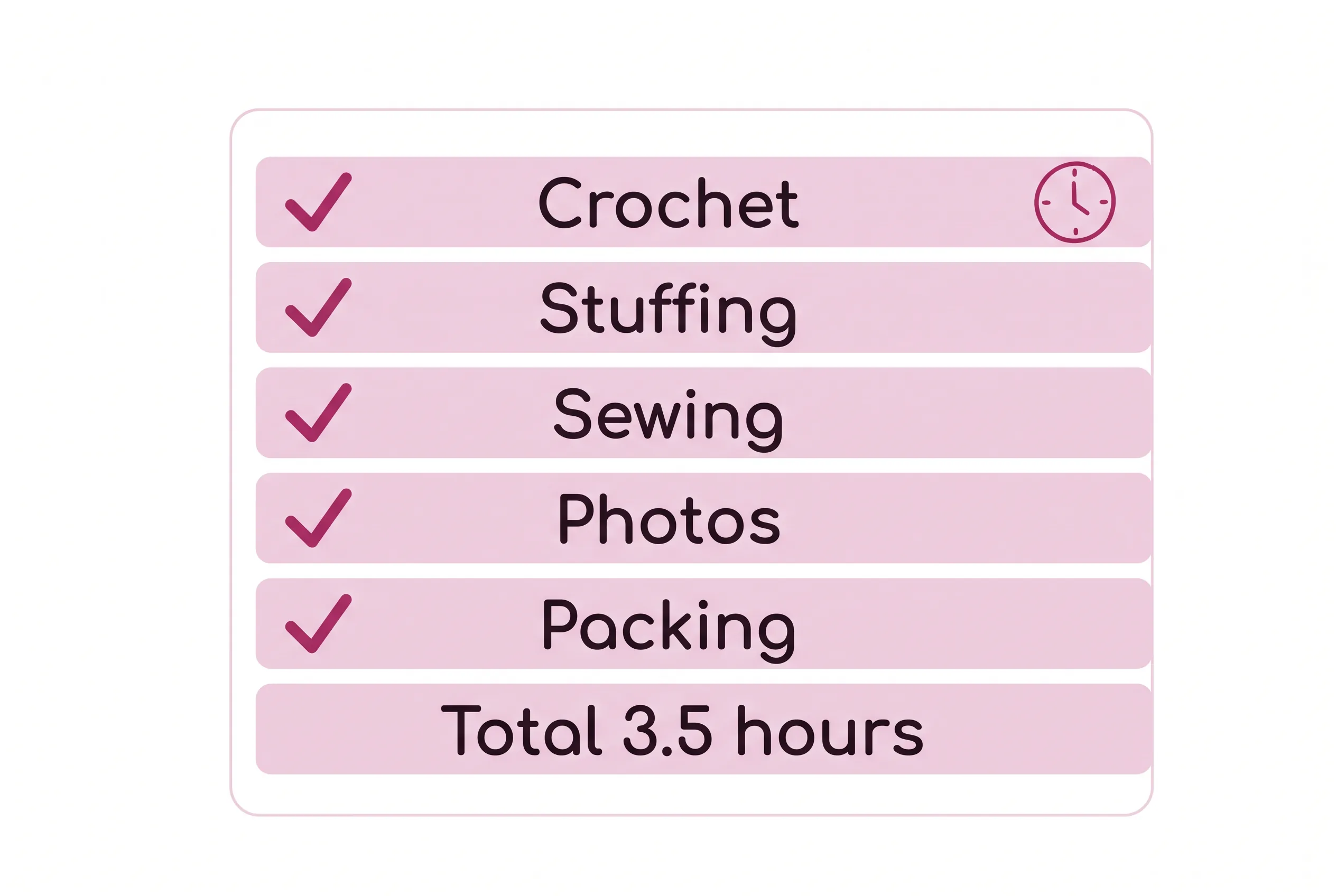
Productive hours do not conclude at the final stitch. Weaving in loose ends, stuffing, attaching components, blocking, photographing, writing the listing and packaging all belong to the individual item. Begin a timer for one complete piece and continue recording through every one of those activities. In the fox example, 3.5 hours might split as 2.5 hours of crochet and 1 hour of finishing, photos and packing.
Your rate is the second half of the hours line. Choose an hourly rate that you would reasonably accept as an employee performing skilled work, and apply it consistently to every item. The examples use $16 an hour as a made-up figure, not a recommendation or a typical wage.
The IRS lists direct labor, materials and supplies among the parts of cost of goods sold in its guide to small business tax. A price built from the same categories therefore corresponds with your accounting records.
Use it when: you say "it only takes an evening" without ever having timed it.
What if the Formula Price Is Higher Than Buyers Pay?
The formula price is the number your costs require, and it says nothing about the market or your skill. Compare it with similar listings, and then calculate what hourly pay each market price would leave you. If that compensation is unacceptably low, change the inputs, in that order, before you cut your wage.
To compare fairly, find listings of the same size, yarn weight and level of detail. A large, tightly stuffed fox is a completely different product from a pocket-sized one. Record several listings rather than a single one, and anticipate a considerable spread between them.
For instance, suppose, for the example only, that comparable foxes list at $45. That price pays (45 − 2.93 − 5.10) ÷ 3.5 = $10.56 an hour. To pay your $16 rate, the fox would have to take about 2.3 hours, because 36.97 ÷ 16 = 2.31. In other words, the gap is a calculation you can work on, and it says nothing about your skill.
- Reduce hours. Simplify a complicated step, reuse a pattern you already understand, or make several identical pieces in one session.
- Reduce the cost per unit. Purchase yarn and safety eyes in bulk and divide the expenditure by the number of finished units.
- Change the item. A smaller, quicker piece may suit the price that customers typically expect. Larger work like the blanket may suit commissions.
- Sell sets. Two foxes in one package increase the order value without doubling the packaging time.
A large piece such as the blanket may suit a commission with a deposit, since the customer agrees the colors and the dimensions before you spend 22 hours. Pricing for a request is the same sum, applied to that order. Consider a custom blanket in the buyer's colors: you add the exact yarn count and the 22 hours. A deposit equal to the $64.00 of yarn means you never fund the materials yourself.
Use it when: your formula price appears excessive next to a listing you saw.
Why Trust This Article
We are the Cosmo Suite team that developed Small Business Bundle, so we gain if you choose a spreadsheet for this. The fox, the blanket, every cost and the $16 rate are made up for illustration, and we checked each total by hand and again with a script. The two shortcuts come from the sources linked above, read on November 23, 2026. This is general information, not tax or financial advice, so check your own numbers. Our editorial policy explains our methodology for researching, writing and correcting articles.
How Small Business Bundle Handles This
The time-consuming part is repeating these calculations for each product and each yarn price change. Small Business Bundle is four linked spreadsheets with 25+ tabs for Excel 365 and Google Sheets, and its Pricing Calculator has 3 tabs for product pricing.
For each item you enter the batch size and cost tables, set a profit margin and read the selling price, net price and real profit. Our walkthrough of pricing a product from materials, labor and fees covers the steps. The bundle is not accounting software or a payment processor, and it does not set prices for you.
If you would rather maintain a pricing sheet for every handmade product you sell, it is a one-time download, not a subscription. For related sums, see how to price handmade items and the cake pricing worked example. Excel and Google Sheets are trademarks of their owners, and we are not affiliated with them.
Frequently asked questions
How much should I charge for a crochet amigurumi?
Charge the price your own costs and margin produce, then compare it with similar listings. In the fox example, $5.10 of supplies and 3.5 hours at $16 an hour give a $61.10 cost. A 25% margin and a 6.5% fee make the price $89.20.
Is yarn cost times three a good pricing rule?
Not for most crochet. Tripling supplies priced the fox at $15.30, which pays about $2.63 an hour after the fee. The blanket fared little better at $5.25 an hour. Hours dominate crochet cost, and a multiple of supplies ignores them.
Should I charge by the hour or by stitch count?
Start with hours, because you can time them and the sums stay simple. Stitch count is a fair cross-check if your speed varies. Whichever you pick, test it on one finished item and see what hourly pay it leaves.
What hourly rate should I use for crochet?
Pick a rate you would accept from an employer for similar skilled work, then use it on every item. The examples use $16 an hour as a made-up figure. Leaving your time at $0 does not remove the cost. It just hides it.
What if my price is higher than other sellers charge?
Check that the listings you compare match in size, yarn and detail. Then work out the hourly pay at their price. If it is too low, cut steps, buy yarn in bulk, make a smaller item or sell sets. Do not quietly drop your wage.
Do I add Etsy fees to crochet prices?
Yes, if you sell there. Put each fee that applies to your shop into the formula. The examples use a 6.5% transaction fee as one sample rate. Check Etsy's current fee page and add the other fees that apply to you.
Sources
Keep reading
Pricing Your Products
How to Price Handmade Items So Your Time Is Paid For
How to price handmade items: a $6.83 candle needs a $13.67 price and a $21.50 crochet headband needs $43.00 once your time and fees are counted.
· 8 min read

Pricing Your Products
Cake Pricing Calculator: Ingredients, Hours and Boxes in One Price
Cake pricing calculator: price an 8-inch cake by counting ingredients, labor, packaging and marketplace fees in a worked example you can adjust.
· 8 min read
Pricing Your Products
Markup vs Margin: The Difference That Quietly Costs Small Sellers Money
Markup vs margin: a 40% markup on a $20 item is only a 28.6% margin. See the table, the two conversion formulas and the price that really earns 40%.
· 8 min read
