Cost-Plus Pricing for Small Businesses: Formula, Examples and When It Fails
Cost plus pricing starts with your full unit cost, then adds a markup. Work through product, cake, and service examples, and see what the formula misses.
By Small Business Bundle by Cosmo Suite · Editorial policy
Published · 8 min read
Cost plus pricing is a way to set a starting price from the cost of one unit, then add a markup. Salesforce defines the method as adding a fixed percentage to a product’s total production cost. Counting the costs in that first number takes care.
For a handmade seller, that can mean materials, hands-on time, packaging, and a share of overhead. Then you still need to check the price against buyer demand and the fees from your sales channel. A cost-plus price is a starting point you can inspect, not proof that the market will accept it. If you want the arithmetic in one place, Small Business Bundle includes a pricing calculator spreadsheet.
In Short: add your full cost per unit and multiply by one plus your markup rate. Review the result against fees, similar offers, and what buyers value before you set the price.
Cost Plus Pricing: A Product Example
Suppose a maker sells a small ceramic bowl. The figures below are fictional and show the calculation method. They are not a recommended price or a market quote.
| Cost for one bowl | Example amount |
|---|---|
| Clay and glaze | $4.20 |
| Labor: 30 minutes at $20 per hour | $10.00 |
| Packaging | $1.30 |
| Allocated studio overhead | $2.50 |
| Full unit cost | $18.00 |
With a 50% markup, the calculation is $18 × 1.50 = $27. The markup adds $9 to the $18 cost. That $9 is not necessarily the amount left after every selling expense. A marketplace fee, payment fee, shipping subsidy, or extra production loss may still reduce it.
This example shows why “materials plus markup” can give a misleading result. The clay and glaze total only $4.20, but the maker also spends time shaping and finishing the bowl. If the labor line is left out, the 50% markup is applied to $8 instead of $18. The resulting $12 price would not cover the example’s full cost.
The Small Business Bundle pricing calculator covers cost inputs and price calculations in more detail. The bundle’s Price Setter supports materials, labor, equipment, and overhead as inputs; the example above is a separate fictional calculation.
When you make a batch, check the actual number of finished items before dividing the cost. If a $180 batch produces ten sellable bowls, each starts with an $18 unit cost. If one bowl cracks and you can sell only nine, the cost per sellable bowl is $20. The amounts are illustrative. The useful habit is to divide by the items you can sell, then write down any waste assumption beside the calculation.

What Is the Cost-Plus Pricing Formula?
The basic formula is:
Selling price = unit cost × (1 + markup rate)
Write the percentage as a decimal before using it. For a 50% markup, use 0.50. For a 25% markup, use 0.25. If the unit cost is $18 and markup is 25%, the price is $18 × 1.25 = $22.50.
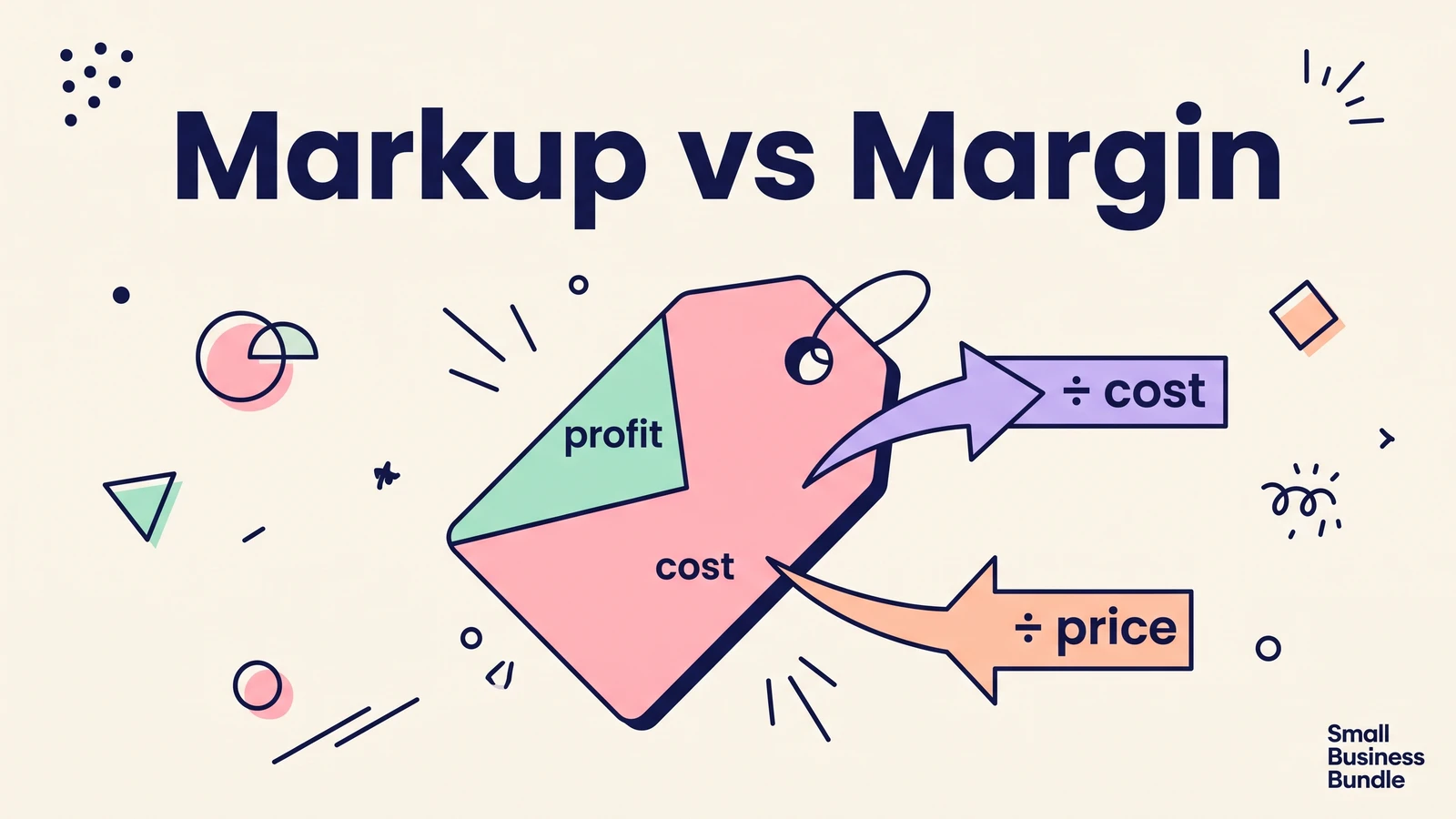
Markup is the amount added to cost, expressed as a share of cost. Margin is profit expressed as a share of the selling price. A $12 cost with a 50% markup gives an $18 price. The $6 difference equals a 50% markup on cost, but it is 33.3% of the $18 selling price, before other expenses. Our guide to markup versus margin with the same price examples walks through that distinction.
If you already have a target margin, do not substitute that percentage directly as a markup. For a target margin, the simple starting formula is price = unit cost ÷ (1 − target margin). On an $18 unit cost and a 40% target margin, that gives $18 ÷ 0.60 = $30 before channel fees or other costs. These formulas describe different targets, so label the cell in your notes as markup or margin.
Three cost checks before you multiply
- Count what goes into one saleable unit. Include typical material waste if it recurs in production. If a batch makes ten items but one is usually unsellable, divide the batch cost by the nine you can sell, not ten.
- Put a value on your time. Use the production time you can support from a sample batch. If a custom job takes different amounts of time, calculate a separate cost for that job.
- Allocate overhead consistently. Choose a basis you can repeat, such as hours used or units made in a period. Do not assign the entire monthly rent to one item, then forget it in every other product.
Keep the notes with the calculation. When material prices or production time change, you can tell which input moved. The small business spreadsheet guide explains how linked records can keep customer, order, and pricing work together.
Three Cost-Plus Pricing Examples
These examples use made-up amounts to show how the same method changes with the job. Replace them with your own records before making a pricing decision.
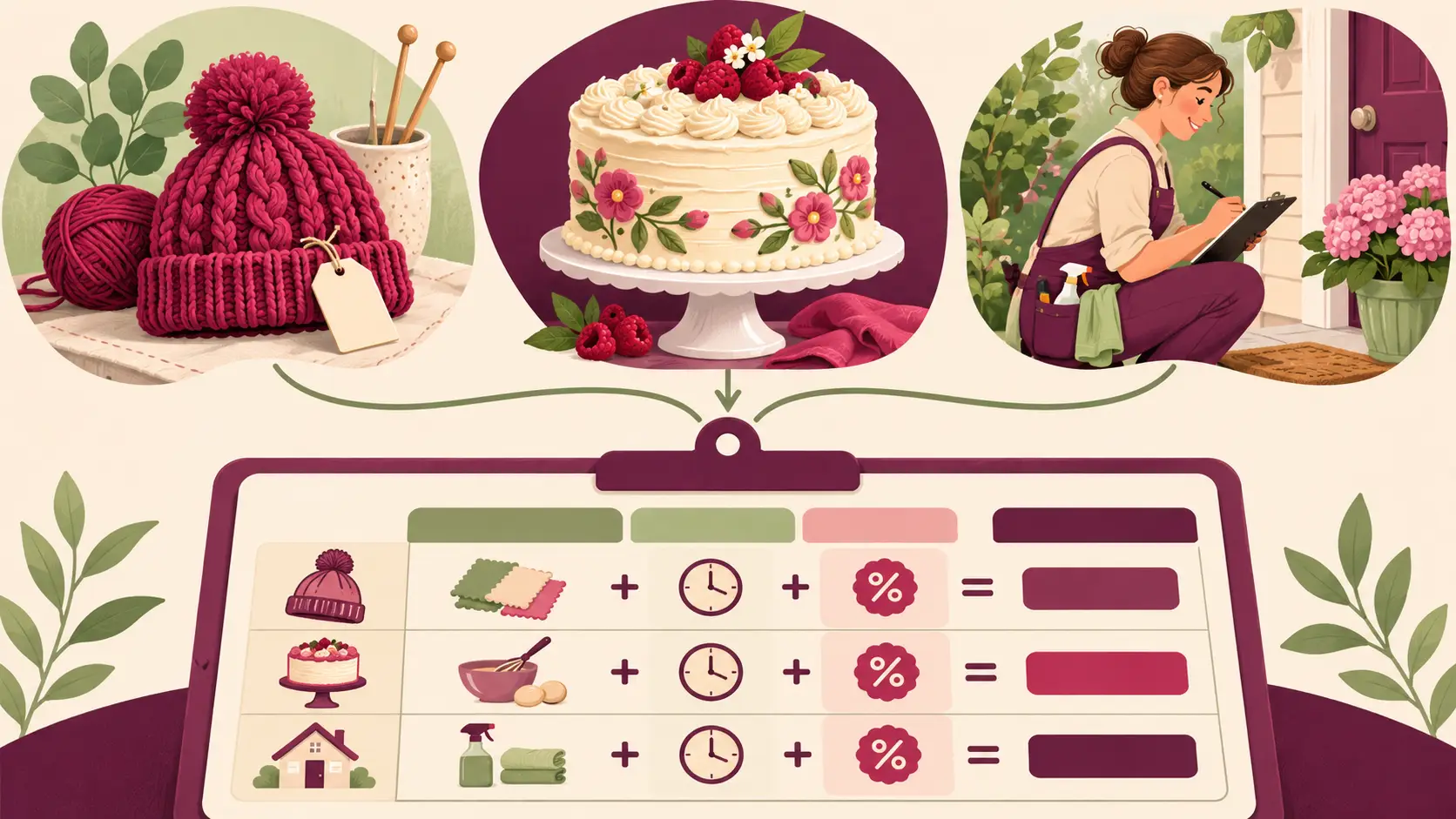
| Example | Full cost | Markup | Cost-plus price |
|---|---|---|---|
| A small handmade product | $18.00 | 50% | $27.00 |
| One decorated cake | $42.00 | 40% | $58.80 |
| A two-hour service visit | $70.00 | 30% | $91.00 |
For the product, the $18 cost matches the bowl calculation above. For the cake, imagine ingredients, board and box, hands-on labor, and allocated kitchen costs add to $42. A 40% markup adds $16.80. For the service, the $70 might include two hours of paid labor plus travel and supplies. A 30% markup adds $21.
The method is useful when you can estimate a repeatable unit or job. A product with a steady batch process may be easier to cost than a one-off repair with unknown parts. For services, track actual time across a few similar jobs before you treat an estimate as typical.
What Does Cost-Plus Pricing Leave Out?
The formula starts with your own costs. It does not tell you whether a buyer sees enough value at that price, or whether the price fits the options around it. Harvard Business Review describes cost-plus as useful in some settings while warning that cost alone can miss buyer value and market conditions. Read the HBR discussion of when cost-plus pricing fits.
Check these items after the first calculation:
- Fees that scale with price: marketplace and payment fees may be a percentage of the order. Estimate them using the current terms for your channel and country. Recalculate when the price changes.
- Shipping and packaging: separate the postage paid by the buyer from what you spend to pack and send the item. A free-shipping offer still has a cost.
- Demand and alternatives: compare similar products, then note what differs in materials, finish, customization, or service. A matching price alone does not make the offers equivalent.
- Capacity: if the price brings more orders than you can make on time, the time estimate or production plan may need another look.
One practical check is to compare the cost-plus result with the amount buyers already pay for similar work. If the price sits above that range, decide whether the difference reflects a feature customers can see. If it sits below, inspect the cost list and labor rate before assuming the lower price is necessary.
This is where cost-plus can underprice a product. A maker might count materials and packaging but use a low labor estimate, leave out a sales fee, or divide batch costs by more units than are sellable. Each choice makes the computed price look neat while the amount left after a sale shrinks.

What Actually Moves a Cost-Plus Price?
Use the formula to make a cost floor visible, then test the price against the buyer’s choice. A better cost record often changes the answer more than a larger markup. Compare similar offers and note what differs in materials, finish, customization, or service. If you raise the price because your work takes longer, make sure the time estimate comes from a repeatable sample rather than one unusually slow order.
If you want a ready-made workbook for those cost inputs, Small Business Bundle includes a pricing spreadsheet. You can also compare a retail price with a wholesale one in this wholesale and retail pricing breakdown.
When Does Cost-Plus Pricing Work, and When Can It Fail?
Cost-plus can give you a consistent floor when the work and costs are reasonably clear. It is less reliable when the unit is hard to define or buyer value changes sharply across versions.
| Cost-plus is a useful starting point when… | Check another angle when… |
|---|---|
| You can count material, labor, and overhead per unit | Each order needs very different work |
| Similar items use a repeatable process | Materials or time vary widely by order |
| You need to update a price after costs change | Buyers choose based on design, rarity, or service |
| You can compare the result with current offers | Your price is far from what buyers see elsewhere |
Salesforce’s cost-plus overview and formula likewise presents the approach as straightforward, while noting that competitor prices and customer response still matter. Treat the equation as one check in your pricing process. A price can cover your counted cost and still be too high for the audience, or leave out a cost and be too low for your work.
Why Trust This Article
We checked the cost-plus formula and its limits against Salesforce and Harvard Business Review on November 4, 2026. The bowl, cake, and service examples are fictional; their figures are arithmetic examples, not customer results. The formula does not predict demand or include every selling cost automatically. The About Us page identifies the team behind Small Business Bundle, and our editorial policy explains how we handle sources.
How Small Business Bundle Handles This
Small Business Bundle includes a Price Setter spreadsheet with three tabs. Its listed inputs include materials, labor, equipment, and overhead, with price, profit, and margin outputs. The bundle is available for Excel and Google Sheets, according to its product contents.
If you want a ready-made spreadsheet for recording those price inputs, see Small Business Bundle. It does not choose a markup or tell you what customers will pay. You supply the costs, review the result, and decide whether the price fits the product and the buyer.
Suggested next step: choose one item you make often and write down the materials, time, packaging, and overhead you can assign to it. Calculate a cost-plus price, then compare it with the current alternatives your buyers see.
Frequently asked questions
What is the cost-plus pricing formula?
Add your full cost for one unit, then multiply by one plus the markup rate. If one unit costs $12 and your markup is 50%, the price is $12 × 1.50, or $18.
Is markup the same as profit margin?
No. Markup compares profit with cost, while margin compares profit with the selling price. A 50% markup on $12 gives an $18 price and a 33.3% margin before other costs.
What costs should I include in cost-plus pricing?
Include the materials, labor, packaging, and a fair share of overhead used to make and sell one unit. Add channel fees separately if they depend on the sale price.
Can cost-plus pricing work for services?
Yes. Estimate the time and other direct costs for the service, add overhead per job, then apply a markup. Check that the final fee fits the work and the market.
Why can cost-plus pricing fail?
The formula uses your costs and markup. It does not show what buyers value or what they will pay, and a missed cost can make the price too low.
Should I include sales fees in my unit cost?
Record fees that change with each sale in a separate line or calculation. A percentage fee changes when your price changes, so treating it as a fixed unit cost can distort the result.
Sources
Keep reading
Pricing Your Products
Product Pricing Calculator: Materials, Labor, Fees and Margin in One Sheet
Product pricing calculator: price one candle from materials, labor, equipment, packaging and fees. A $7.85 unit cost becomes a $15.70 price at a 40% margin.
· 9 min read
Pricing Your Products
Markup vs Margin: The Difference That Quietly Costs Small Sellers Money
Markup vs margin: a 40% markup on a $20 item is only a 28.6% margin. See the table, the two conversion formulas and the price that really earns 40%.
· 8 min read
Pricing Your Products
How to Price Crochet Items: Yarn, Hours and a Price People Pay
How to price crochet items: a fox amigurumi works out at $89.20 and a throw blanket at $607.30 once yarn, paid hours, fees and margin are counted.
· 9 min read
